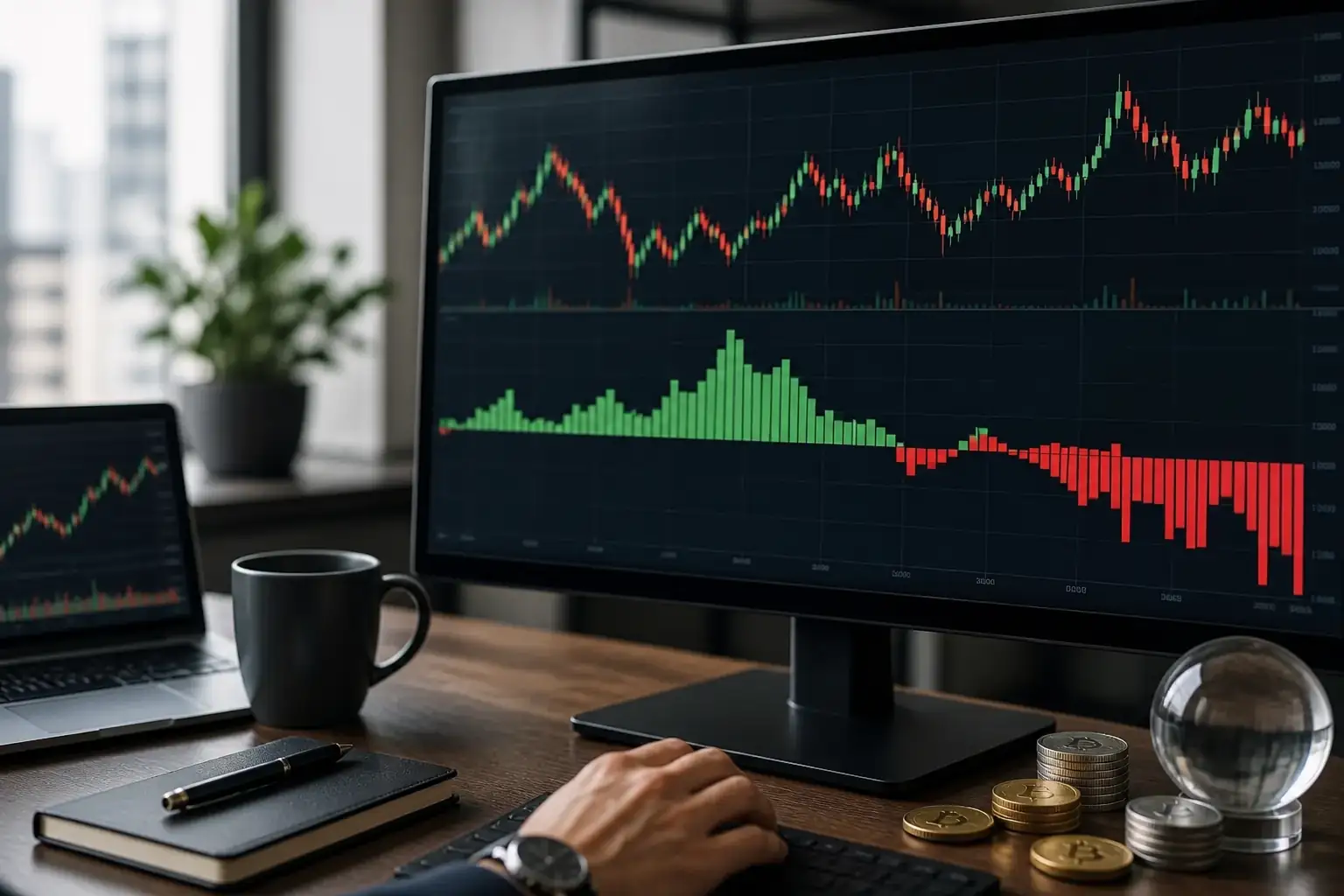
A price can rise quickly without the increase being really solid. It can also drop suddenly when the market seemed calm a few minutes earlier. In both cases, the key question is not just where the price is going, but who is actually pushing the movement: buyers or sellers.
Buyer/seller pressure refers to the balance of power between those who want to buy an asset and those who want to sell it. When buyers dominate, they are willing to pay more to enter. When sellers dominate, they agree to sell lower to exit. For an investor, this reading allows you to understand whether a movement is based on a true conviction or on a simple temporary movement in the price.
This notion is particularly useful in crypto, where movements can be rapid, emotional and amplified by leverage. It naturally complements the reading ofcapital flow, because it shows how this liquidity is concretely transformed into pressure on the order book.
What does buyer/seller pressure mean?
In a market, each transaction involves a buyer and a seller. But that doesn’t mean both sides have the same urgency. An aggressive buyer agrees to buy at the asking price to get in immediately. An aggressive seller agrees to sell at the available price to get out quickly.
Buying pressure occurs when buyers take the initiative. They absorb available sales, raise the price and show that they are willing to pay more. Selling pressure occurs when sellers set the pace. They absorb purchases, push the price down and show that they want to exit, even at less favorable prices.
The difference is important: a market can go up simply because there are few sellers, or because buyers are really aggressive. In the first case, the movement may lack depth. In the second, it is based on a more visible demand.
Why does this concept matter so much?
The price is the bottom line. Buyer/seller pressure helps to understand what is happening before or during this outcome. It answers a simple question: is the movement driven by an active force, or only by a temporary lack of opposition?
When a rise builds with regular buying pressure, declines are often more likely to be defended. Buyers are returning to important areas, supports are holding up better and the market is giving an impression of construction.
Conversely, if the price rises while buying pressure runs out of steam, the movement becomes more fragile. The last buyers sometimes come in late, sellers start distributing, and a correction can come sooner than expected.
How to spot it concretely
There is no single magic indicator to measure this pressure. It is often read through several data: volumes, CVD, the order book, candles, wicks, support and resistance zones, and sometimes the evolution of open interest.
THECVD, for example, helps see if aggressive buying exceeds aggressive selling. If the price rises and the CVD also progresses, buyers follow the movement. If the price rises but the CVD stagnates or falls, there may be a divergence: the market is rising, but the buying pressure is not really confirming.
Candles also give clues. Closes near the highs often show that buyers remained in control until the end of the period. Repeated high wicks can on the contrary show that sellers regain control as soon as the price rises.
Strong pressure does not mean automatic signal
Strong buying pressure does not mean you have to buy immediately. It can appear at the start of a real trend, but also at the end of a movement, when the crowd enters late. In the same way, strong selling pressure can announce a bearish continuation or mark a capitulation close to a rebound.
Context makes all the difference. Buying pressure on a major support does not have the same meaning as buying pressure after several days of vertical increase. Selling pressure in contact with resistance can be logical, while selling pressure on already weakened support can herald a breakout.
This is why we must always connect this notion to thegeneral market management, technical areas and overall feeling.
What beginners should remember
The role of this notion is not to predict each candle. It serves to avoid a common mistake: looking only at the price and forgetting the balance of power behind the movement.
When the price rises with strong buyers, consistent volumes and a healthy market structure, the move appears more credible. When the price rises but buyers weaken, sellers absorb each increase and buyersliquidationsget closer, the risk increases.
Conversely, a decline is not always negative. If sellers gradually lose intensity, buyers start to absorb, and the market approaches a support zone, the environment can become more interesting.
Limits to keep in mind
Buyer/seller pressure can change very quickly. An announcement, a significant liquidation, a change in Bitcoin or a traditional market opening can reverse the balance of power in a matter of minutes. We must therefore avoid freezing our analysis.
We must also be wary of false signals. Some movements are caused by stops, arbitrages or spot orders. They can give the impression of strong pressure even though it is mainly a technical event.
In other words, this notion sheds light on the ongoing fight. It does not replace risk management, nor the analysis of the level at which the fight takes place. Used with supports, resistances, capital flows and liquidations, however, it becomes one of the most useful readings for understanding who is really in control of the market.