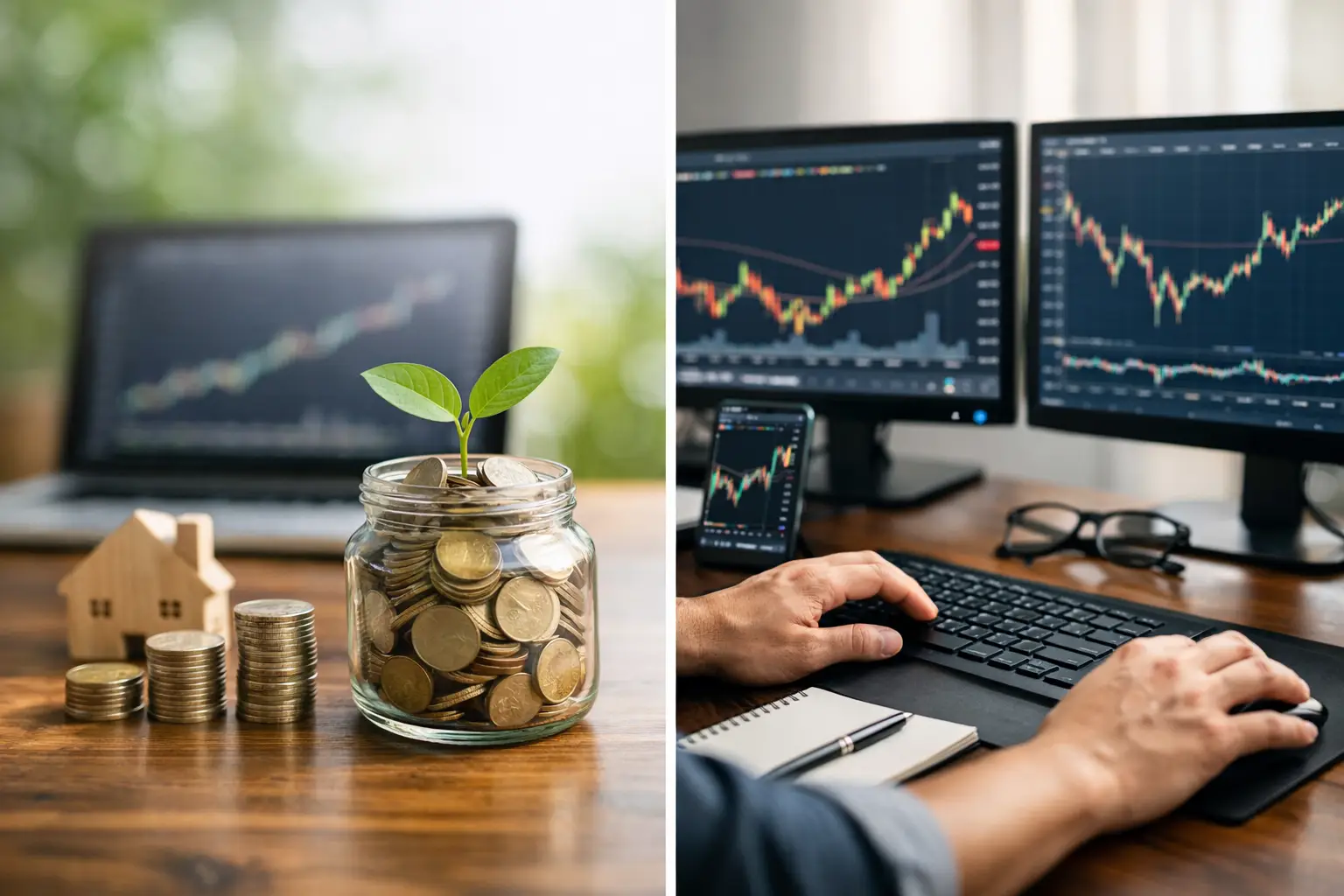
You open your investment app, you see a portfolio that moves every day, and the same question quickly comes up: passive investment or trading? Behind this choice, there is not only a style preference. There is a different relationship to time, risk, mental effort and the way of building your wealth.
The real issue is not which approach is more impressive. It’s a matter of knowing which one you can apply consistently for months or even years. Many individuals get into trading because it seems faster. Many then give up because they discover that speed does not replace method or discipline.
Passive investment or trading: two opposing logics
Passive investing consists of exposing oneself to a market or a set of assets over the long term, with little intervention. The idea is simple: rather than trying to constantly beat the market, we seek to capture its overall growth over time. This can be through ETFs, solid stocks held for a long time, or certain diversified allocations to crypto and traditional assets.
Trading is based on more frequent decisions. The trader seeks to profit from price variations in the short or medium term. It can take place over a few days, a few hours, sometimes less. This approach requires more presence, more rules and better tolerance for uncertainty.
Neither method is naturally superior in all cases. They meet different objectives. Passive investment favors progressive accumulation. Trading favors the exploitation of market opportunities, with a much higher level of involvement.
What you’re really trading: time for simplicity
The first criterion to look at is not the expected return. This is the time available.
A passive portfolio can be built with a few structuring decisions: choice of envelope, allocation, investment frequency, rebalancing rules. Then, most of the work consists of sticking to the plan. The difficulty is not technical. It is behavioral. You have to agree not to react to every market noise.
Trading requires something completely different. You have to observe assets, understand trends, define entry and exit points, manage risk, monitor your results and correct your mistakes. The time spent is not a detail. It is an integral part of the strategy.
This is why an employee, a self-employed person or a parent with little availability does not have the same constraints as a person very involved in monitoring the markets. If you can only devote thirty minutes a week to your investments, trading quickly becomes a source of sloppy decisions.
Potential yield and statistical reality
Trading is attractive because it gives the impression that a faster return is possible. This is true in theory. In certain contexts, a skilled trader can outperform a passive strategy. But this potential is accompanied by a less visible reality: consistency is difficult, mistakes are expensive and the majority of individuals underestimate the role of psychology.
Passive investing is less spectacular. It doesn’t promise to enjoy every move. On the other hand, it is based on better documented historical dynamics: long-term economic growth, capitalization, diversification, reduction of transaction costs and limitation of decisions.emotional.
In other words, trading can produce better results in certain hands, but it can also significantly degrade performance if the method is weak. The passive often offers a less nervous trajectory in terms of decision-making, even if market volatility remains present.
Passive investment or trading according to your profile
For a beginner, the most reasonable starting point is often passive investing. Not because it would be perfect, but because it allows you to learn without multiplying mistakes. We understand diversification, average purchasing cost, the role of time and the impact of market cycles.
Trading can come later, provided it is approached as a skill to be built, not as a shortcut to performance. An individual who trades without a journal, without a risk plan and without a time frame is not following a strategy. He improvises.
For a mid-level self-investor, the right answer may be hybrid. It is common to see a passively managed asset base, then a smaller pocket dedicated to trading. This separation has a clear advantage: it avoids confusing long-term accumulation and tactical risk-taking.
In the crypto world, this distinction is even more useful. Volatility is higher, narratives change quickly and emotional exposure can become excessive. Keeping a conviction allocation over the long term while reserving a limited portion for tactical operations often allows you to better control your decisions.
Risk is not only in the market
When we compare passive investing or trading, we first think about the risk of financial loss. It’s normal, but it’s not the only one.
Trading adds operational risk. A position size error, misused leverage, a stop moved under stress, or overactivity after a loss can degrade an account quickly. The risk then comes as much from behavior as from the market itself.
Passive investing has other limits. It exposes you to long periods of decline, sometimes very uncomfortable. It requires putting up with boredom when the market stagnates, and frustration when a more active strategy seems to do better in the short term. The risk is then to abandon the plan at the wrong time.
In both cases, the central question remains the same: can you follow your method when the market gets tough? A strategy is only valuable if it remains executable under pressure.
Fees, taxation, mental friction
An often underestimated point concerns invisible costs. Trading generates more transaction fees, sometimes financing costs, and a much higher volume of decisions. Even if each cost seems small, adding them together can reduce performance.
The passive generally benefits from more efficient mechanics. Less arbitration, less back and forth, less short-term stress. This does not mean that there is no work, but the mental load is often lower.
Taxation can also weigh in on the choice. Depending on the accounts used, the country of residence and the frequency of transactions, the implications will not be the same. An individual investor has an interest in thinking in terms of net return, after costs and after taxes, not just in terms of gross performance.
How to choose without telling a story
The best method is often the one that you are able to repeat without tiring yourself out. To check this, ask yourself simple questions.
Do you want to build capital over ten years or generate short-term opportunities? Do you have real working time to devote to the markets? Can you tolerate high variability in results? Are you ready to document your decisions, analyze your mistakes and accept periods of no gains?
If the answer is no to many of these questions, passive probably makes more sense. If the answer is yes, trading can be studied,but with a strict framework and realistic expectations.
It is also useful to test before deciding. A passive plan can be started immediately on a simple basis. Trading can be done on a small scale, with written rules, logbook and monthly report. This test often reveals the truth faster than a theoretical debate.
A mixed approach is often healthier
Many retail investors seek an absolute answer, while the most stable solution is sometimes intermediate. A two-story structure works well for many profiles: a passive base for heritage construction, and an active pocket for learning, testing and exploiting certain market configurations.
This logic makes it possible to protect the essential while maintaining space for experimentation. It also limits a common bias: transforming all your assets into a playground because you have a few good trades in a row.
Among users of analysis tools like those of Yapuka Investir, this distinction takes on even more meaning. The data then serves to strengthen the method, not to justify permanent agitation.
A good framework remains simple. Define what part is long term, what part is short term, what criteria trigger a decision and under what conditions you reduce your exposure. The clearer your rules are, the less your emotions drive.
An AI or an automated agent can help make this framework more usable on a daily basis. It can aggregate market data, filter out noise, spot recurring signals, track your assets without fatigue and save you valuable time on analysis. This does not replace your judgment or responsibility, but it reduces the mental load and improves the quality of your decisions. The good use of technology is not to promise gains. It’s to help you see more clearly, more quickly, to invest with a better method.