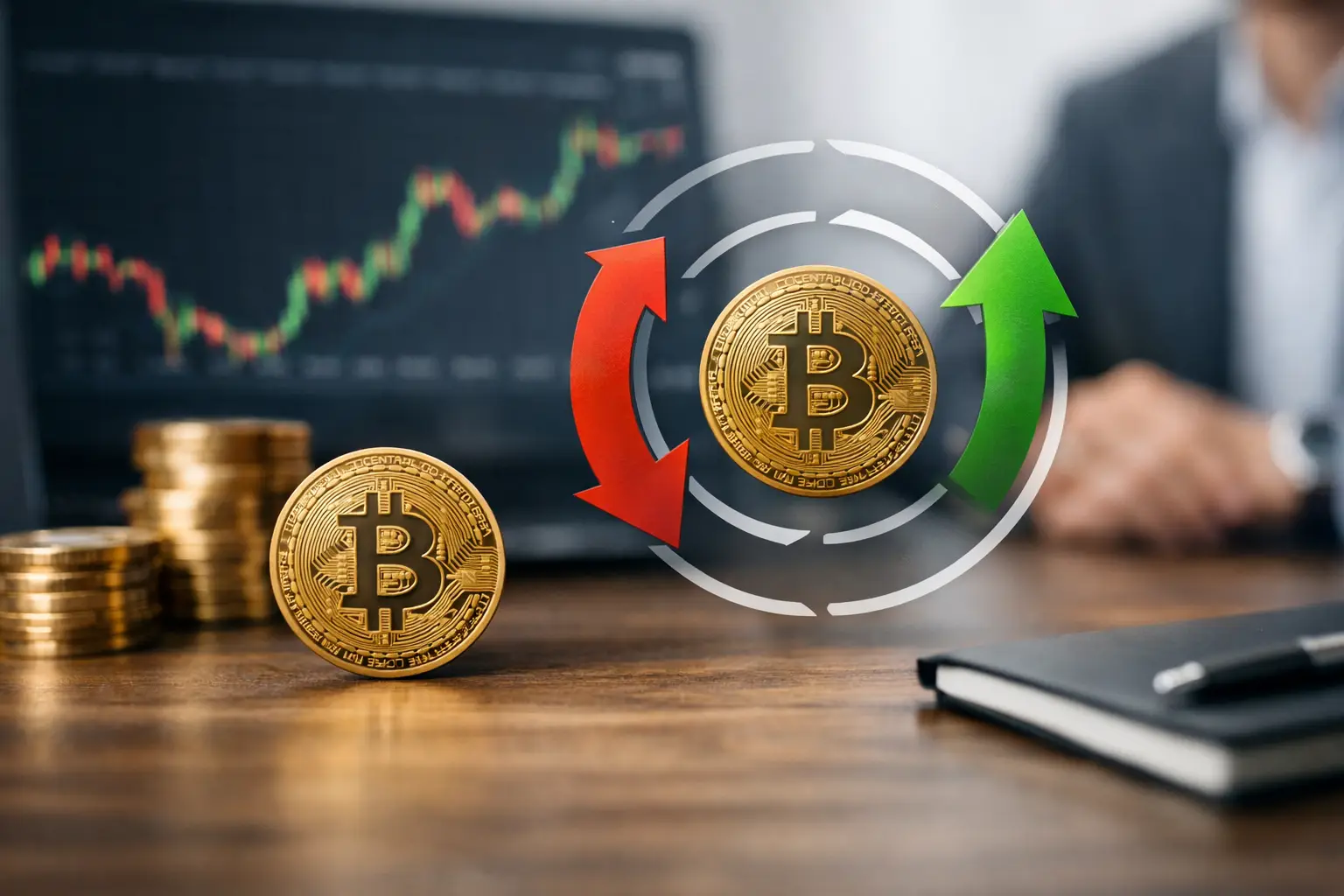
A long-term investor in Bitcoin doesn’t always lose because of a bad asset. More often, they lose because of poor emotional timing. They buy when everyone is calling it genius, panic when the market corrects, and then doubt at the worst moment. Understanding the bitcoin cycle is primarily about avoiding this trap.
The goal isn’t to predict the exact price of BTC in three months. The goal is much more useful: to put what you see into a broader context. When you understand where the market is in its cycle, you make calmer, more consistent, and often more profitable long-term decisions.
Why the Bitcoin Cycle Really Matters
Bitcoin doesn’t rise in a straight line. It moves in phases. There are rather quiet accumulation periods, strong rallies that attract public attention, and sometimes sharp corrections. This movement is not abnormal. It’s exactly what has characterized the market since its inception.
The problem is that many investors only look at today’s price. They see a red candle and think everything is collapsing. Or they see a bullish surge and imagine they must buy quickly before it’s too late. Without a cyclical view, every fluctuation seems huge. With a cyclical view, the noise becomes more bearable.
For a HODLer, this vision is essential. It allows you to build a strategy that doesn’t depend on the market’s short-term mood. It also helps distinguish a simple correction from a deeper phase change.
What Is the Bitcoin Cycle in Practice?
The bitcoin cycle refers to the succession of major phases the market goes through over time. They can be described simply.
First, there is an accumulation phase. The market comes out of a sharp decline, media interest drops, and many retail investors have already left the scene. It’s often a boring period. Precisely for this reason, it flies under the radar.
Next comes the recovery phase. Signals improve, the price picks up, patient players strengthen their positions, and confidence gradually returns. The market isn’t euphoric yet, but something is changing.
Then comes the acceleration phase. This is usually when attention explodes. The media talk about Bitcoin again, searches increase, new entrants arrive, and the rally goes wild. This period can be very profitable, but also very dangerous for those discovering the market at this stage.
Finally, we enter a distribution phase followed by a correction. Excesses are paid for, volatility increases, the market loses strength, and those who bought in the euphoria start to doubt. This isn’t necessarily the end of Bitcoin. It’s often just the end of a phase.
The Halving Influences the Bitcoin Cycle, But Doesn’t Explain Everything
The bitcoin cycle is often associated with the halving, which is the programmed reduction in the issuance of new bitcoins. Historically, this event has often preceded major bull markets. The reason is simple: a lower new supply, on an already scarce asset, can strengthen upward pressure if demand remains strong.
But be careful not to oversimplify. The halving doesn’t automatically trigger an immediate rally. The market also depends on global liquidity, interest rates, risk appetite, ETF behavior, long-term sales, and the macroeconomic context.
In other words, the halving provides a useful framework, not a guarantee. If you’re investing seriously, you need a broader perspective than just the halving calendar.
How to Read a Cycle Without Becoming an Analyst
This is often where many give up. They want to understand the market, then stumble upon dozens of indicators, complicated charts, and conflicting opinions. Result: mental overload, paralysis, then unclear decisions.
In reality, you don’t need to follow everything. To read a cycle simply, you mainly need to observe a few major signal families.
The price is useful, of course, but it’s not enough on its own. You also need to see if the underlying trend remains bullish or not, if long-term investors are holding their positions, if market activity is rising out of conviction or euphoria, and if the macro context supports or hinders risky assets.
This is where artificial intelligence can really save you time. Its purpose isn’t to replace your judgment. Its role is to filter, synthesize, and prioritize important signals. Instead of opening twenty sources and trying to reconcile everything yourself, you get a clearer read on the market’s current state.
For individual investors, this makes a real difference. You stay in control, but you remove much of the noise that causes fatigue and hesitation.
What Investors Often Confuse
Many think identifying a cycle means finding the perfect bottom and the perfect top. That’s a mistake. Even experienced investors can’t do this consistently.
The realistic goal is simpler: avoid the worst decision zones. For example, investing heavily only when the market is overheated, or selling in fear after a big correction, are two typical behaviors of an investor who doesn’t read the cycle.
On the other hand, a disciplined investor accepts not catching every extreme. They mainly aim to act in the right general direction. Accumulate when the market is under pressure but the long-term structure remains healthy. Slow down when euphoria becomes excessive. Reassess exposure when several signals deteriorate at once.
This approach is less spectacular than aggressive trading. It’s often better suited to real life.
A Simple Strategy to Use the Bitcoin Cycle
If your goal is to build a long-term position, the bitcoin cycle can serve as a framework, not a crystal ball. In practice, this means you can keep a regular buying strategy over time, while slightly adjusting your exposure level according to the market phase.
During accumulation or early recovery periods, some investors choose to strengthen more confidently, as the market often offers better entry points and less euphoria. During acceleration phases, they may continue to buy, but with more caution. And when the market becomes clearly excessive, they may decide to secure some gains or at least stop overweighting Bitcoin.
There is no single right method. It all depends on your time horizon, risk tolerance, conviction level, and the role of Bitcoin in your overall portfolio. Someone investing for ten years won’t act like someone who needs liquidity in eighteen months.
The most important thing is to avoid improvised decisions. A simple plan, reviewed regularly, is better than an emotional reaction to the latest market move.
The Value of Structured Monitoring Over Obsessive Tracking
Watching the market every hour doesn’t give you more control. More often, it increases stress and pushes you to act too quickly. For long-term investors, the key is to follow the right information, at the right pace.
Structured monitoring lets you know if the cycle is evolving, if the trend remains constructive, and if the risk level is changing. It also reduces that sense of uncertainty that drives you to read everything and its opposite on social networks.
This is precisely where a platform designed for the long term can help. If it turns complex data into understandable signals, it saves you time and helps you stay consistent with your strategy. Yapuka Holder follows this logic: simplifying the reading of the Bitcoin market so you can decide more clearly, without spending your evenings on unreadable dashboards.
The Bitcoin Cycle Doesn’t Replace Risk Management
Understanding a cycle doesn’t protect you from everything. Bitcoin remains a volatile asset. Even in a bull cycle, corrections can be violent. Even in a bear cycle, strong rebounds can trap investors.
That’s why you need to stick to a few simple rules. Don’t invest an amount you can’t handle seeing fluctuate sharply. Don’t base your entire strategy on a single scenario. Don’t confuse long-term conviction with blind faith.
Reading the cycle helps you better situate yourself. It doesn’t exempt you from managing your exposure, investment horizon, and acceptable stress level.
When you start seeing Bitcoin as a market in phases rather than a series of incomprehensible jolts, you already gain an advantage. Not because you predict the future better, but because you react less poorly to the present. And in the long run, this difference often matters much more than one more indicator.