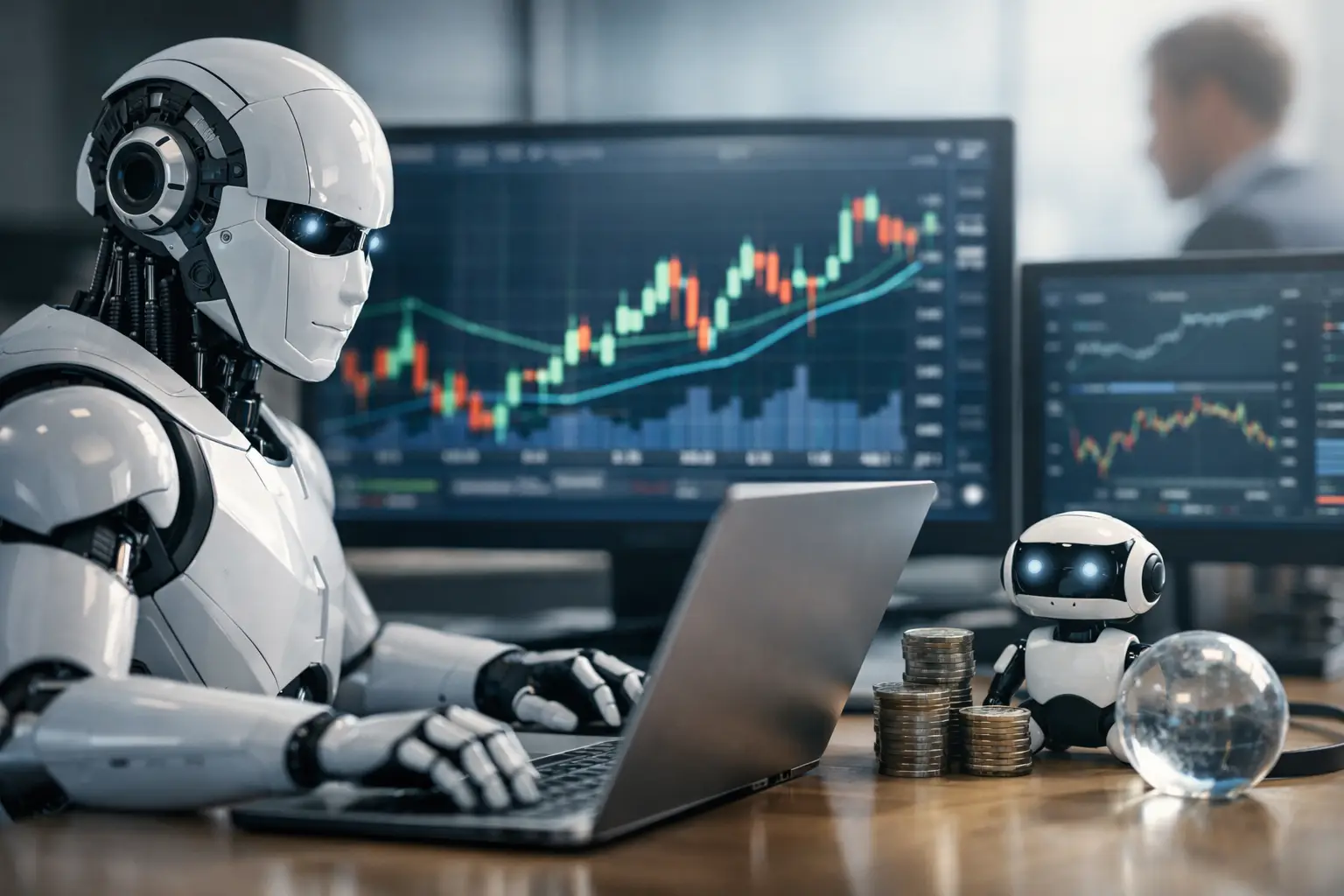
Searching for “trading robot reviews” quickly reveals a striking contrast: on one side, promises of automatic income; on the other, stories of rapid losses and frozen accounts. This gap is not anecdotal. A robot is neither a guarantee of performance nor necessarily a scam: it is a program that applies rules to an uncertain market. The quality of these rules, market conditions, and your risk management make all the difference.
For individual investors, the right question is not “which robot always wins?” Instead, you should ask: what does this tool actually do, what data does it rely on, under what conditions can it fail, and how much control will I retain?
Trading Robots: Reviews, Between Promises and Reality
A trading robot, also known as algorithmic trading or a bot, automatically executes buy and sell orders based on a set of parameters. These parameters can be simple, such as buying when a moving average crosses a threshold, or more complex, involving multiple indicators, position sizing rules, and exit mechanisms.
Some robots only send alerts. Others place orders directly via a connection to a broker or crypto platform. This distinction is crucial: an analysis tool does not carry the same risk as a program authorized to move your capital without manual validation.
Positive reviews deserve to be read methodically. A good experience may result from a favorable market period, a modest capital, or a strategy whose real risk remains hidden. Conversely, a negative review does not alone prove a robot is faulty: the user may have changed settings, stopped the strategy at the wrong time, or committed too much capital.
The problem is that testimonials do not replace verifiable data. A spectacular chart over a few weeks says nothing about a strategy’s ability to withstand a bear phase, a sideways market, or a sudden spike in volatility.
What a Robot Can and Cannot Do
The main benefit of automation is discipline. A program can monitor multiple assets, apply a rule tirelessly, and avoid certain emotional reflexes, such as chasing a move out of fear of missing out. It can also be useful for executing a predefined strategy, especially when crypto markets operate continuously.
But automation does not turn a weak strategy into a profitable one. If the initial rules are poorly designed, the robot will simply apply the error faster and more consistently. It does not spontaneously understand a market regime change, a major macroeconomic announcement, or a liquidity break—unless these situations were anticipated in its design.
Another often overlooked point concerns fees. Each order can generate commissions, slippage (the difference between expected and actual price), and sometimes financing costs on leveraged products. A seemingly profitable strategy before fees can become mediocre or even negative once these factors are included.
Criteria to Check Before Trusting a Review
Strategy Transparency
A reputable seller does not have to disclose all their source code. However, they should be able to clearly explain the general logic: covered assets, time frame, entry and exit conditions, trade frequency, maximum exposure, and main risks.
Be wary of vague phrases like “secret intelligence,” “self-evolving algorithm,” or “technology that anticipates the market” without usable proof. Artificial intelligence can analyze large volumes of data and detect patterns, but it does not predict the future with certainty. If an explanation does not allow you to understand the risk taken, it does not allow you to make an informed decision either.
Results Measured Under Proper Conditions
Backtesting involves applying a strategy to historical data. It is useful for eliminating some unlikely ideas, but it is not proof of future performance. A strategy can be overfitted to the past: it looks excellent because it was calibrated on known events, then disappoints as soon as the market changes.
Look for out-of-sample results, meaning tested on a period not used during design, and ideally real-world performance over a sufficient duration. Also check if results include commissions, slippage, and unfavorable periods. A short track record, presented without maximum drawdown or fee details, provides little useful information.
Maximum drawdown is a particularly concrete indicator. It measures the largest loss between a portfolio peak and the following trough. Two robots may show similar annual returns but have very different paths. One may temporarily lose 8%, the other 45%. Depending on your financial situation and risk tolerance, these two profiles are not comparable.
Risk Control
Before using a robot, focus less on the potential gain and more on what it could lose in a tough scenario. Does the strategy use stop-losses? Can it multiply positions after a loss? Does it automatically increase order size? Does it use margin or leverage?
Martingale-type systems, which increase bets to try to recover a loss, sometimes produce reassuring performance curves for a long time. Their weakness appears during an unusual but possible adverse sequence. Just because a risk is rare does not mean it is acceptable for your portfolio.
Also set a personal limit: the maximum amount allocated to the robot, the maximum loss you can tolerate, and your stop condition. The capital entrusted to an automated strategy should remain compatible with your goals, investment horizon, and your ability to absorb a loss without making rash decisions.
Security and Operational Framework
A robot connected to an exchange or brokerage account is also a security concern. Never grant more permissions than necessary. An API key dedicated to trading should not allow fund withdrawals. Two-factor authentication, unique passwords, and regular account monitoring are basic precautions.
Also check the company’s identity, fee structure, fund custody method, and available support. A robot can be technically sound yet associated with an opaque structure. Requests for urgent deposits, guaranteed returns, unverifiable screenshots, and aggressive referral programs are red flags that should make you pause.
How to Test Without Turning the Trial Into a Gamble
The best approach is to proceed step by step. Start by understanding the robot’s rules and observe its behavior in simulation or with limited capital. Don’t judge the system after three winning or losing trades: note the context, decisions made, and differences between expected and actual behavior.
Track a few simple indicators: net return after fees, win rate, average gain, average loss, drawdown, number of trades, and maximum exposure. A high win rate is not necessarily good if rare losses wipe out many small gains. Conversely, a strategy may have fewer winning trades yet remain consistent if its average gains clearly exceed its average losses.
Avoid changing parameters every time the market shifts direction. This often amounts to replacing a method with emotional reactions. Any change should address a specific hypothesis and be tested before applying it to real capital.
Useful Automation Starts With a Human Decision
A trading robot can be a relevant tool to structure a method, monitor markets, and reduce the burden of repetitive tasks. It should not become a blind delegation of your financial decisions. Your role remains to choose exposure, evaluate results, understand the limits, and know when not to act.
An AI or specialized agent, like those used by Yapuka Trader, can help analyze data, spot signals to watch, compare scenarios, and save time monitoring markets. Its value lies in informing your judgment and reducing mental load, not in promising profits. A clearer decision always starts with understood rules, measured risks, and control that remains in your hands.