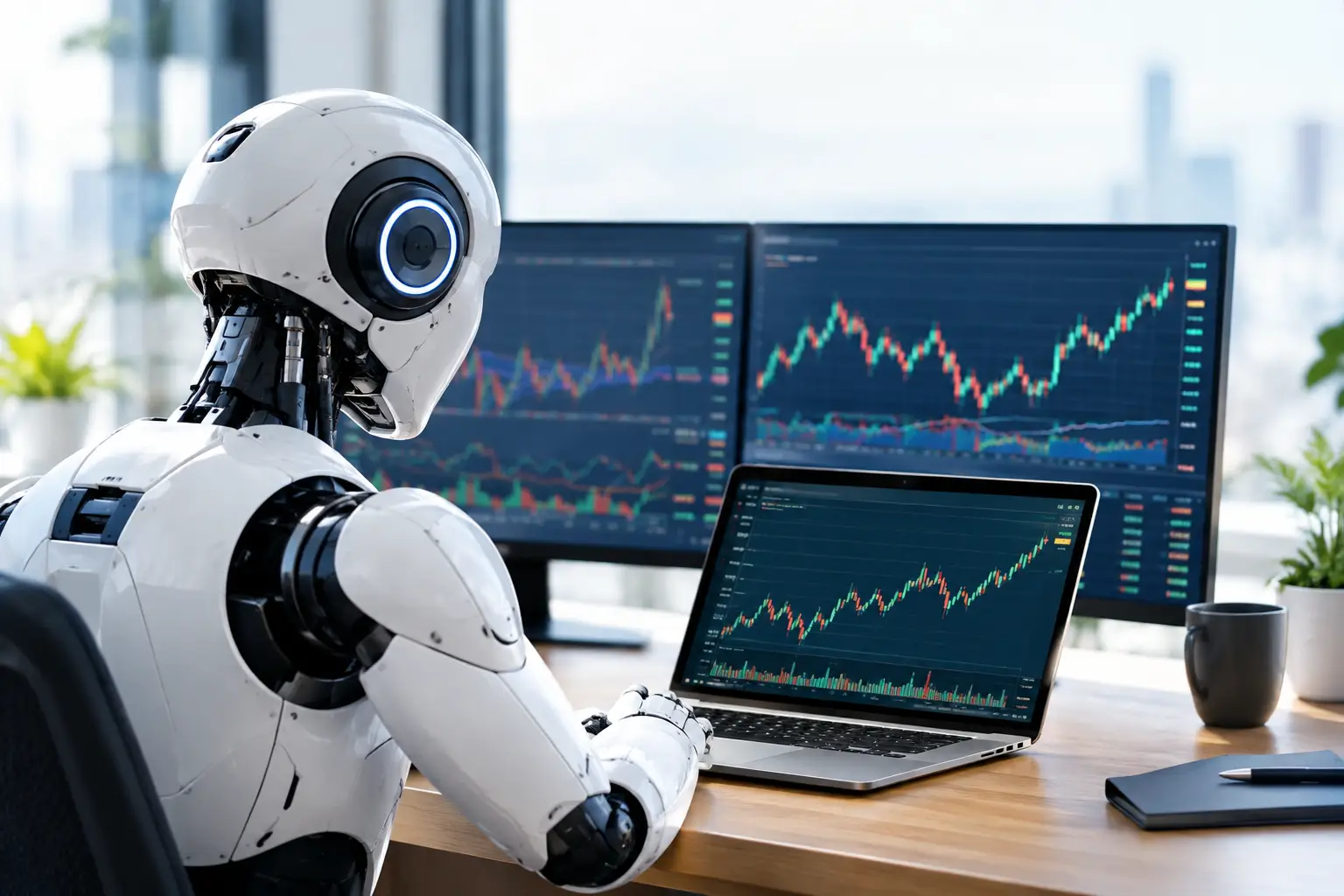
A robot boasts 80% winning trades, executes orders while you sleep, and promises flawless discipline. The scenario is enticing. Yet, behind the question “are trading robots reliable?”, the real issue is more precise: reliable for what purpose, under what conditions, and with what level of risk? Software can apply rules consistently. It cannot turn a fragile strategy into a money-making machine.
For individual investors, a trading robot should be seen as a tool for execution and analysis, not as a guarantee of returns. Its value depends on the logic driving it, the data used, fees, the technical quality of its integration, and above all, your ability to understand its limitations.
What does a trading robot actually do?
A trading robot, also called a bot or algorithm, is a program that follows predefined instructions. It can monitor an indicator, trigger a buy when two conditions are met, place a stop-loss, or rebalance a portfolio at regular intervals. Some bots rely on simple rules. Others use statistical models or artificial intelligence methods to classify signals.
This automation brings a concrete advantage: it removes some of the emotion from execution. A robot does not panic at a red candle and does not chase an asset for fear of missing a rally. It does exactly what it is told, with a speed that is hard to match manually.
But this strength is also its limitation. The bot does not spontaneously understand that a central bank announcement, a major crypto hack, or a period of low liquidity can make its rules less relevant. It keeps acting until a preset condition stops it or a human intervenes.
Are trading robots reliable depending on their use?
Reliability is not binary. It must be assessed according to the task assigned to the robot.
For automating a clear task, such as buying a fixed amount each month, rebalancing an allocation, or systematically placing a protective order, an automated tool can be very reliable operationally. It reduces oversights and follows a routine defined in advance. This does not mean the initial decision is good, but the execution can be consistent.
For exploiting a short-term strategy, the answer is more nuanced. A bot can be reliable as long as the market resembles the data on which its rules were designed. But markets change: volatility, volumes, correlations between assets, and transaction costs evolve. A strategy that is profitable during a bull phase can rack up losses in a sideways or sharply bearish market.
Finally, when a service promises regular gains, low risk, and almost automatic performance, maximum caution is needed. No serious robot can eliminate market risk. A series of good results, even if verifiable, does not prove the system will perform well tomorrow.
A good backtest is not enough
Backtesting involves applying a strategy to historical data. It is a useful step to check if the rules have behaved consistently in different contexts. But it is easy to create flattering results by endlessly tweaking parameters until the past looks perfect. This is called overfitting.
Imagine a bot that works admirably because its entry threshold was tuned to the nearest hundredth on the past three years’ data. This level of precision may reflect no lasting logic. At the first market regime change, the advantage disappears.
A serious evaluation combines several elements: a long enough history, both bull and bear periods, inclusion of fees, spread and slippage, and tests on data the strategy has never seen. Slippage is the difference between the expected price and the actual price obtained during execution. On illiquid assets or during fast moves, it can significantly degrade real results.
Demo account or paper trading results provide an extra layer of validation. However, they remain imperfect, as a simulated order does not always face the same constraints as a real one. The best approach is to start with a limited amount, defined as a learning budget, and observe the system’s behavior before scaling up.
Criteria to check before entrusting your capital
Before using a robot, first seek to understand its method. You do not need access to the source code, but you should be able to answer these questions simply: which assets does it track, on what timeframe does it operate, what logic triggers its positions, and in what case does it stop trading? If the operation remains deliberately mysterious, you cannot assess the risk.
Then review the performance with perspective. A win percentage is not enough. Look at the maximum drawdown, meaning the largest drop in capital between a peak and a trough. A robot showing great profitability but able to lose 45% before recovering requires a high risk tolerance. Also check the duration of results, the number of trades, and whether there is any independent track record.
Fees deserve the same attention. Monthly subscription, platform commissions, funding fees, price spreads, and taxes can reduce or even wipe out a theoretical edge. In frequent trading, a few fractions of a percent per trade quickly become significant.
Security is also crucial, especially in crypto. A bot should not be given withdrawal authorization on your account. Prefer API keys limited to trading, enable two-factor authentication, and immediately revoke unused access. Do not deposit your funds on an opaque platform just because it offers an integrated robot.
Warning signs not to ignore
Certain signs should make you pause. Fixed returns announced every month, promises of “zero risk,” screenshots without verifiable data, or pressure to deposit quickly are incompatible with a serious investment approach.
Be wary of martingale-type robots. This method often increases position size after a loss to try to compensate. It can show an impressive success rate for a long time, then suffer a very large loss during a prolonged move. The risk is sometimes hidden by attractive statistics.
Another common issue concerns copy trading systems presented as autonomous robots. Copying another trader’s decisions does not give you access to their constraints, total capital, or ability to handle losses. What suits their profile is not automatically suited to yours.
A cautious method to test a bot
Start by defining the goal: saving time on execution, testing a strategy, managing an allocation, or trading more frequently. Without a clear objective, it becomes difficult to measure the robot’s real usefulness.
Next, set risk rules before activating the tool. Determine the maximum portion of your capital involved, the maximum acceptable loss, and the circumstances that would lead you to stop the test. These thresholds should be set calmly, not after several losses.
During the first weeks, compare each automated decision with the announced rules. Did the bot execute at the expected price? Does it respect the defined limits? Are the results still consistent once fees are included? Keep a simple journal with the date, order reason, result, and any discrepancies.
Finally, avoid changing parameters after every losing trade. A strategy should be judged over enough trades and in a known market context. Constantly tweaking a bot often means replacing an imperfect method with a series of emotional, just-automated decisions.
An AI agent or automated tool can help apply this discipline without replacing your judgment. It can analyze market data, detect unusual changes, summarize a bot’s performance, and alert you when a risk threshold is crossed. Tools like Yapuka Trader can also reduce mental load by organizing useful information. Their role is to help you decide more clearly, not to predict the market or guarantee profits.