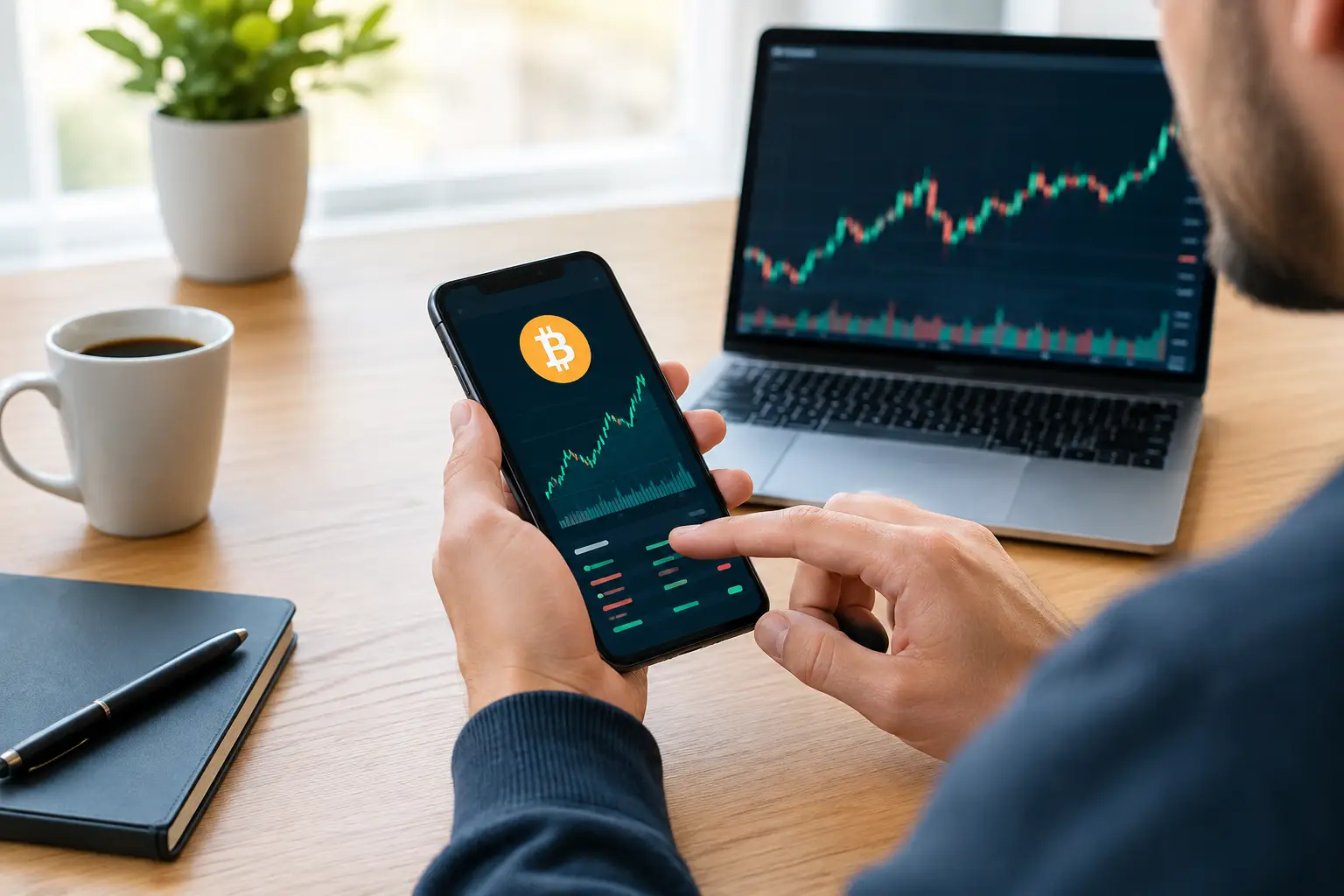
A Bitcoin portfolio may seem simple: a balance, a price that moves, and a few purchases made over the months. However, the question “how to track your Bitcoin portfolio” quickly becomes more delicate when you want to know what you really own, what you’ve invested, and whether your strategy remains consistent. The goal is not to watch the price all day. It’s to keep a clear vision, without adding stress to your investment.
For a long-term investor, good tracking is not about anticipating every fluctuation. It’s mainly about checking that your decisions remain aligned with your goal: gradually accumulating Bitcoin, protecting your capital, and avoiding impulsive reactions.
Why track your Bitcoin portfolio?
The price displayed on an app only tells part of the story. If you bought Bitcoin at different times, on several platforms, or in different currencies, your total balance is not enough to measure your situation.
Structured tracking answers very concrete questions: how much BTC do you really hold? How much have you invested? What is your average purchase price? What share of your wealth does Bitcoin represent? And most importantly, are you still comfortable with this level of exposure if the market drops sharply?
Without these benchmarks, many investors swing from one extreme to another. They feel left behind after a rise, then worried after a drop. A clear table reduces this mental load. It puts the numbers in context and leaves less room for decisions made on emotion.
How to track a Bitcoin portfolio with the right numbers
You don’t need fifty indicators. For a long-term investment strategy, four data points are enough in most cases: the number of bitcoins held, the total amount invested, the average purchase price, and the current value of the position.
The number of BTC is your most important data. The price in euros can change every minute, but your amount of Bitcoin only changes when you buy, sell, or transfer funds. This distinction helps you stay focused on your accumulation rather than daily noise.
The total amount invested is the actual money paid to acquire your bitcoins, including fees. It allows you to calculate your average purchase price. For example, if you invested 3,000 euros to get 0.06 BTC, your average price is 50,000 euros per BTC. This figure is often more useful than your first purchase price, as it reflects your real strategy over time.
Finally, compare the current value of your portfolio to the amount invested, but don’t make it a constant alarm. This comparison helps you measure the overall evolution of your position. It shouldn’t become a reason to sell just because the market has dropped for a few days.
Don’t confuse performance with strategy
A significant gain doesn’t automatically mean you should sell. Likewise, a temporary loss doesn’t mean your plan is bad. It all depends on your time horizon, your need for liquidity, and the place of Bitcoin in your wealth.
If your goal is to hold for several years, good tracking first helps you check that you can handle volatility. Too high an allocation can push you to sell at the wrong time. An appropriate allocation makes fluctuations easier to live with.
Centralize your purchases to avoid forgetting
The problem often arises after a few months. A first purchase on one platform, a recurring purchase on another, then a transfer to a personal wallet. Without a centralized history, it becomes difficult to find your average price and to distinguish deposits from gains or losses.
You can track your operations in a simple table. For each movement, note the date, the amount invested, the number of BTC received, the fees, and where the bitcoins are stored. This method works well if you have few transactions and are meticulous.
But it has a limit: it takes time and remains fragile. A forgotten line, a transfer counted as a purchase, or ignored fees quickly distort the result. Investors who use scheduled purchases often benefit from relying on a tool that aggregates and interprets data rather than maintaining a manual spreadsheet.
The key is to clearly separate three actions: buying Bitcoin, transferring Bitcoin, and selling Bitcoin. A transfer between your purchase platform and your personal wallet does not affect your performance. It only changes the location of your funds.
Track your Bitcoin portfolio without monitoring the market continuously
Checking the price ten times a day rarely leads to better decisions. For a Bitcoin holder, this habit can even increase stress and the urge to react to every red or green candle.
Instead, choose a tracking rhythm that fits your strategy. An investor who buys every week can check their portfolio once a week to make sure purchases are recorded. An investor who adds monthly can do a monthly review. In both cases, a more complete review each quarter is usually enough.
During this review, ask yourself simple questions. Does your Bitcoin exposure still match the percentage you planned? Are your purchases still compatible with your budget? Have you kept an emergency fund outside of cryptocurrencies? Are your bitcoins stored where you want them?
This routine brings more value than short-term predictions. It lets you correct an imbalance before it becomes a source of pressure.
The indicators that deserve your attention
Market indicators can help, as long as you don’t turn them into a prediction machine. For a long-term approach, focus on understanding where the market is in its cycle, the general level of confidence, and whether euphoria or fear dominates decisions.
An indicator is never a buy or sell order. It provides context. When several signals show an excess phase, you can slow your purchases or review your allocation. When the market goes through a downturn, you can check if your plan calls for continued accumulation and if your budget allows it.
Artificial intelligence can be useful at this stage. It doesn’t replace your judgment or eliminate risk. However, it can filter repetitive information, summarize trends, and present important elements without forcing you to follow dozens of charts and sources every day.
Security is part of tracking
A well-tracked portfolio is not just one whose value you know. It’s also a portfolio whose access you control. Regularly check where your bitcoins are held: on a platform, in a software wallet, or on a hardware wallet.
If you keep your keys yourself, your recovery phrase must remain private, offline, and protected against loss. Do not store it in an email, a shared document, or a photo on your phone. No serious person will ever ask you for this phrase.
If part of your funds remains on a platform, enable two-factor authentication and use a unique password. For many investors, separating the amount used for regular purchases from the amount kept long-term brings more clarity and security.
Build a dashboard that really helps you
The best dashboard is the one you can check and understand in just a few minutes. If it drowns you in numbers, it doesn’t help. You should be able to see your BTC amount, your average price, your allocation, and major market events without becoming an analyst.
This is precisely the benefit of an approach like Yapuka Holder: turning market and portfolio data into clear benchmarks for the long-term investor. The goal is not to tell you what to do, but to save you time so you can decide more calmly.
Whether you’re an employee, renovation entrepreneur, plumber, electrician, mechanic, hairdresser, beautician, or landscaper, the problem is the same: you don’t need to add hours of analysis to your days. Simple tracking lets you stay in control without making Bitcoin a second job.
Your portfolio should give you useful information, not another reason to worry. Set your rules, check the right numbers at a reasonable pace, and let your long-term strategy do what it was designed for: move forward with consistency.