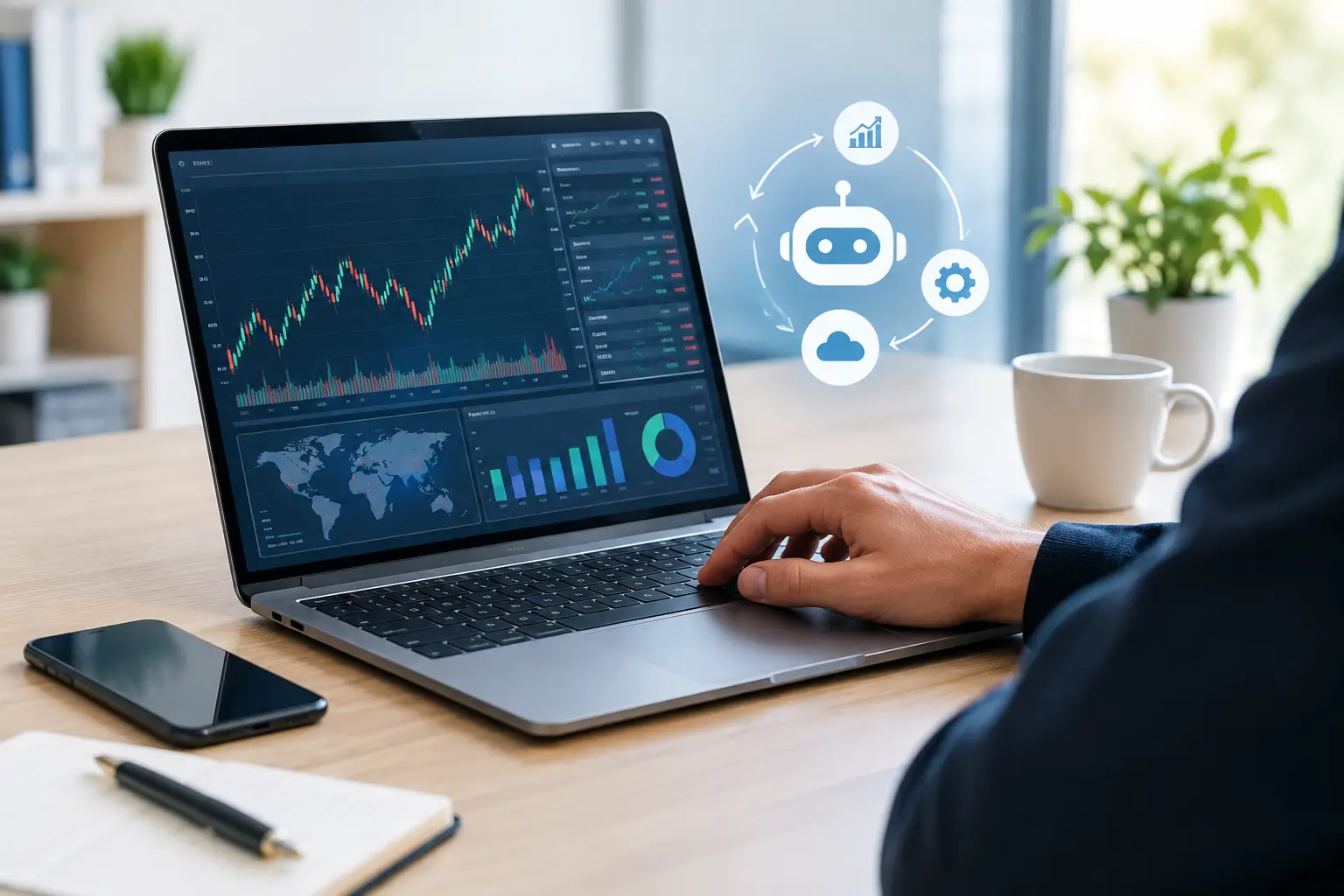
A central bank publication can move the markets within minutes. A quarterly result, an inflation figure, or a rumor about a crypto ETF can also change the context. Trying to read everything is unrealistic. Automating your financial market monitoring allows you to receive relevant information at the right time, without confusing speed with haste.
For individual investors, the goal is not to replicate a trading floor. It’s about building a simple system that tracks your holdings, events likely to influence a decision, and signals that deserve verification. Useful monitoring reduces noise but does not replace a strategy or risk analysis.
Start by defining what your monitoring should track
The most common mistake is setting up dozens of alerts before defining your needs. The result is predictable: a flood of notifications, then the habit of ignoring them. Good automation starts with a concrete question: what information could lead me to review my analysis, my risk level, or my investment timeline?
For long-term investors, company results, outlook changes, central bank decisions, inflation, and interest rate trends may be priorities. For more active traders, unusual volumes, technical level breakouts, volatility, and scheduled announcements are more important. In crypto, you often need to add platform flows, token unlocks, regulatory decisions, and security incidents.
Start with a short list: your current positions, a few assets under watch, major macroeconomic indicators, and dated events affecting your horizon. This selection forms your monitoring universe. Without this step, automation mainly amplifies your distraction.
Distinguish information, signal, and decision
Information is a fact: a company publishes results, a central bank changes rates, an economic indicator is released. A signal is information interpreted in context: the publication is well above expectations, the market reacts strongly, or a tracked threshold is crossed.
The decision remains your responsibility. A signal does not automatically mean “buy” or “sell.” It indicates that it may be useful to review your thesis, examine your exposure, or wait for confirmation. This distinction protects against impulsive reactions, especially when markets are volatile.
Organize sources before automating financial market monitoring
Not all sources are equal. Speed is useful, but reliability is more important. For company data, official publications and regulatory documents are generally more solid than a comment circulating on social media. For macroeconomics, prioritize statistical agencies, central banks, and recognized economic calendars.
Financial media and analysts can provide context, as long as you distinguish facts from opinion. Social networks can help spot emerging topics, especially in crypto, but should not become a source of validation. A widely shared rumor is not confirmed information.
Create three levels of sources. The first gathers primary sources, consulted to validate a major event. The second groups quality media and analysis, useful for understanding possible consequences. The third contains faster or community feeds, to be considered as leads to verify. This hierarchy prevents treating every notification with the same importance.
Build an alert system that remains readable
An alert should correspond to a specific condition and a possible action. A price alert may be relevant near a level you’ve identified, but not if it triggers on every minor fluctuation. Similarly, a news alert should target keywords related to your assets or themes, not the entire market continuously.
You can associate alerts with three timeframes. Immediate alerts concern rare and potentially material events: unexpected publication, significant price movement, security incident, or major regulatory announcement. Daily alerts group variations, news, and data worth reviewing calmly at the end of the session. Weekly alerts help review underlying trends, allocation, and upcoming deadlines.
The delivery channel also matters. A phone notification is suitable for truly urgent events. An email summary or dashboard is often preferable for the rest. If your phone rings ten times a day for inconsequential information, your system is too sensitive.
Set thresholds rather than track every move
Thresholds should be linked to your plan, not your anxiety. For a long-term holding, a daily 1% move may be irrelevant. A sharper drop, combined with a change in fundamentals, deserves a review. For a trader, the threshold may depend on the asset’s usual volatility, a technical level, or abnormal volume.
Avoid universal rules. A 5% move does not mean the same for a bond, a tech stock, and a cryptocurrency. The alert should be calibrated to the asset, your horizon, and your position size.
Centralize data to keep context
Receiving information is only part of the job. The real benefit comes from centralization. A personal dashboard can bring together price, performance, upcoming events, recent publications, tracked levels, and a few notes on your investment thesis.
This overview is especially useful when several signals arrive at once. A drop in an asset may seem worrying in isolation, but becomes more understandable when placed in the context of a sector correction, a rate decision, or a global risk-off move.
Also keep a decision journal. Briefly note why you opened a position, what would invalidate your scenario, and what risk you accept. When an alert triggers, you can compare the event to your initial plan rather than react emotionally in the moment.
What automation should not do for you
Automating monitoring does not mean blindly delegating decisions. Some pitfalls remain common: tracking too many indicators, giving too much weight to isolated news, or using an alert as an implicit buy or sell order.
The risk is even higher with systems that automatically summarize news. A summary may omit nuance, misrepresent the certainty of information, or fail to account for your personal situation. Check important facts at the source, especially before a significant decision.
You should also schedule review time. Once a week, ask yourself which alerts were useful, which generated noise, and whether your thresholds still match your strategy. Effective automation evolves with your portfolio and experience.
Use AI as a filter, not an oracle
An AI or AI agent can analyze large volumes of data, classify news by asset or theme, detect recurring keywords, and produce a readable summary. It can also link market moves to economic events, flag unusual volatility, or remind you of important deadlines. For individuals, this filtering saves time and reduces the mental load of constant monitoring.
The most relevant use is to assign it verifiable tasks: summarize announcements for your asset list, compare market reactions, extract key figures from a publication, or highlight upcoming events. You then retain control over interpretation, risk management, and the final decision.
An automated tool, such as the specialized agents offered by a platform like Yapuka Trader, can help organize information and spot signals that deserve your attention. It does not predict market movements with certainty and guarantees no gain. Its value is more concrete: helping you decide with more method, context, and calm.