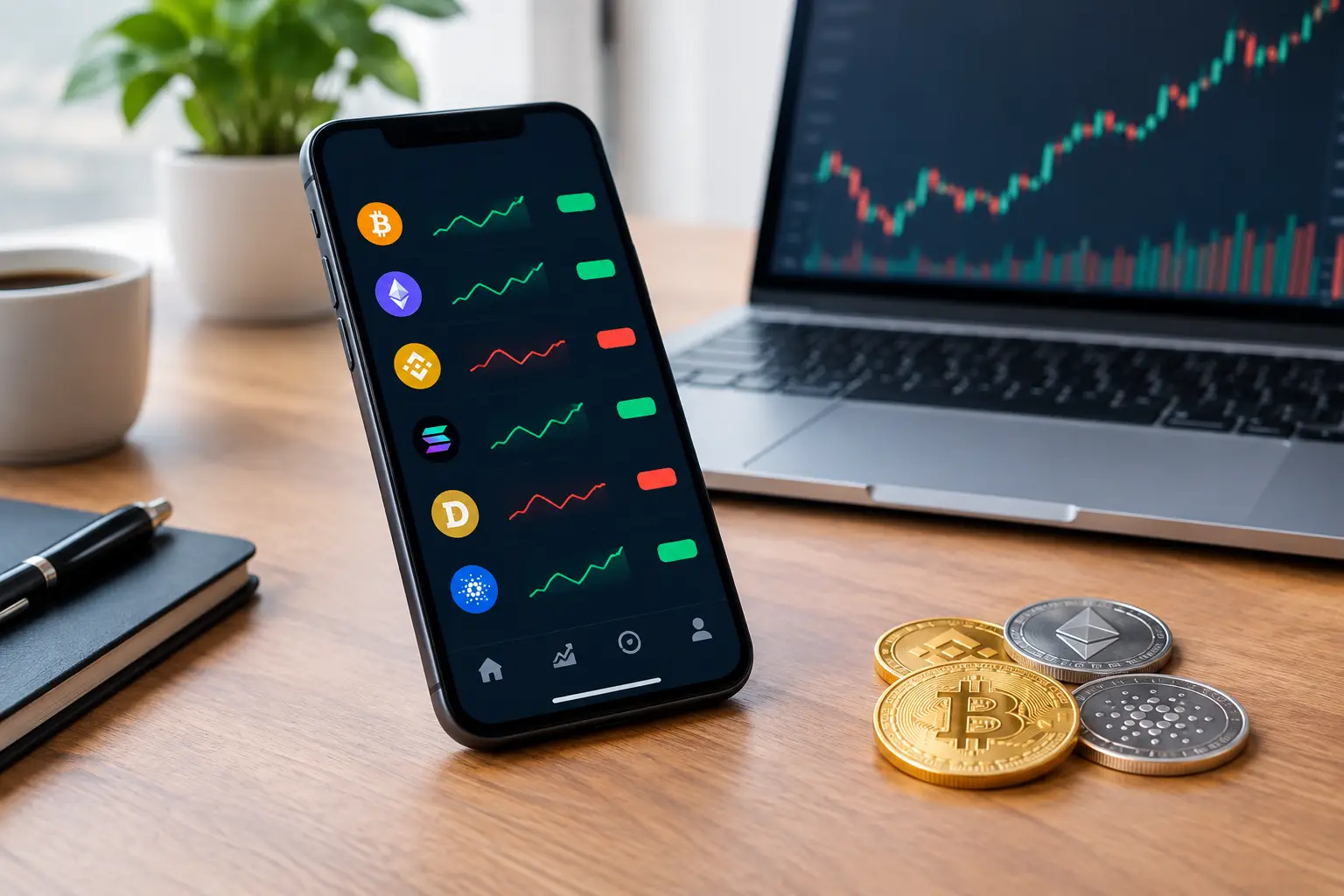
A good crypto app comparison is not about naming a single “best” app for everyone. An investor who buys bitcoin every month does not have the same needs as a trader who follows several markets daily, nor as someone who wants to hold assets for several years. The key is to choose a tool that matches your method, your level of autonomy, and your risk tolerance.
The most common pitfall is to compare only the displayed fees or the number of available cryptocurrencies. These factors matter, but they don’t tell the whole story. Fund security, interface clarity, price spreads, withdrawal conditions, and data quality directly affect your experience and sometimes the actual outcome of your decisions.
Crypto app comparison: the three main categories
Before comparing app names, it’s useful to distinguish their roles. Many disappointments come from mismatched expectations: an app designed for simple buying won’t replace a platform built for active trading, and vice versa.
Buying and investing apps
These focus on simplicity. Users can usually deposit euros, buy a few major assets, and set up recurring purchases. Their interface is often reassuring for beginners, with clean charts and few complex order types.
This approach suits a gradual strategy, provided you check the total cost. A visible commission may seem low, but a gap between the displayed purchase price and the market price, called the spread, can increase the bill. For long-term investors, simplicity may justify a slightly higher cost. For frequent operations, it quickly becomes a drawback.
Centralized exchange platforms
These apps generally offer access to more cryptocurrencies, several order types, and more detailed transaction fees. You’ll often find limit orders, which let you set a buy or sell price, as well as more comprehensive tracking tools.
However, they require more discipline. The many products offered, especially leverage or derivatives, can create the illusion that you must be active all the time. But a more advanced tool does not automatically improve your strategy. For beginners, it’s reasonable to start with spot functions and master the basics before considering more complex products.
Non-custodial wallets and decentralized apps
With a non-custodial wallet, you directly control the keys that grant access to your crypto assets. This autonomy reduces your reliance on a platform, but also gives you major responsibility: safeguarding your recovery phrase and verifying every transaction.
These tools provide access to decentralized finance, asset swaps, and some on-chain services. They are useful for investors already comfortable with blockchain networks. However, they come with specific risks: address errors, fake sites, malicious permissions, and variable network fees. Sovereignty does not mean risk-free, but rather that risk shifts to the user.
The criteria that truly make a difference
Comparing apps using a simple grid helps avoid being swayed by advertising or a slick interface. The following criteria should be considered together, as an excellent score in one area does not necessarily make up for a major weakness in another.
Visible fees, spread, and withdrawal costs
First, look at buy and sell fees, then check for a spread. Compare the app’s displayed price with a reference price observed at the same time on the market. The gap is especially important for smaller, often less liquid assets.
Add deposit fees, euro withdrawal fees, and crypto transfer fees. An app that’s cheap to buy on may charge more for withdrawals. If your goal is to regularly transfer assets to a personal wallet, pay special attention to this point.
Security and regulatory framework
No app completely eliminates risk. However, you can look for concrete signals: two-factor authentication, login alerts, withdrawal address whitelists, possible segregation of client funds, and a clearly explained custody policy.
The regulatory framework also matters. Check that the service is authorized or registered where required in your country, and read the asset custody terms. This doesn’t guarantee a company’s future strength, but it helps you understand who holds the funds, what procedures are in place, and what recourse may exist.
Security also depends on your habits. A unique password, two-factor authentication, and caution with urgent messages often protect you more than a so-called revolutionary feature. Never share a recovery phrase, even with supposed customer support.
Liquidity and execution quality
Liquidity refers to the ability to buy or sell an asset without significantly moving its price. For major cryptocurrencies, it’s usually good on established platforms. For lesser-known tokens, the gap between buy and sell prices can be significant.
To assess an app, test with small amounts if possible and observe the final price before confirming. Limit orders may be preferable to instant buys when the market is volatile. They don’t guarantee execution, but give you better control over the accepted price.
Usability, information, and taxes
A good app should help you understand what you’re doing, not push you to click. Transaction history, average purchase price, downloadable statements, and configurable notifications are more useful than a constant stream of anxiety-inducing alerts.
Taxes are often overlooked when choosing. An app that provides clear history makes it easier to track your portfolio and prepare your tax returns. If you use multiple platforms and wallets, set up a consistent tracking system from the start. Reconstructing transactions months later is rarely pleasant.
Which app for your profile?
For a beginner looking to invest gradually, a simple, regulated app with transparent fees is often the most rational choice. Focus on assets you understand, controlled recurring purchases, and impeccable account security. The initial goal is not to catch every market move, but to build a method.
For a self-directed investor, an exchange platform offering competitive fees, limit orders, and detailed exports can provide more control. You’ll need to dedicate time to analysis, risk management, and tracking your operations.
For an experienced user interested in decentralized finance, a non-custodial wallet is a complement, not necessarily a total replacement. It may make sense to keep some funds on a platform for euro conversions, and another portion in a personal wallet depending on your time horizon and technical skills. This allocation should remain understandable and documented.
A simple method to compare without getting lost
Choose a maximum of three apps and give each a personal score for fees, security, simplicity, withdrawals, and analysis tools. Give more weight to criteria related to your actual use. If you invest once a month, the speed of an advanced trading module is secondary. If you make regular transfers, withdrawal fees become a priority.
Next, do a limited test: create the account, activate security protections, check the history, simulate or make a small transaction, then verify the withdrawal process. This test often reveals more than marketing promises. Don’t deposit a significant amount before understanding the full process.
Avoid multiplying apps without reason. Each extra account increases administrative burden, the risk of forgetting, and the difficulty of tracking your overall exposure. Diversifying providers can be considered depending on the amount and risk level you accept, but it shouldn’t become uncontrolled dispersion.
Turning information into a decision-making tool
The right choice is not the app with the most features, but the one that lets you apply your strategy with discipline. An AI, AI agent, or automated tool can help centralize market data, track major changes, compare your positions to your initial rules, and reduce the mental load of constant monitoring. Tools like those developed by Yapuka Trader can turn scattered information into more readable elements. They don’t predict profits or replace your judgment: their value is in saving you time, spotting signals to check, and helping you make clearer decisions.