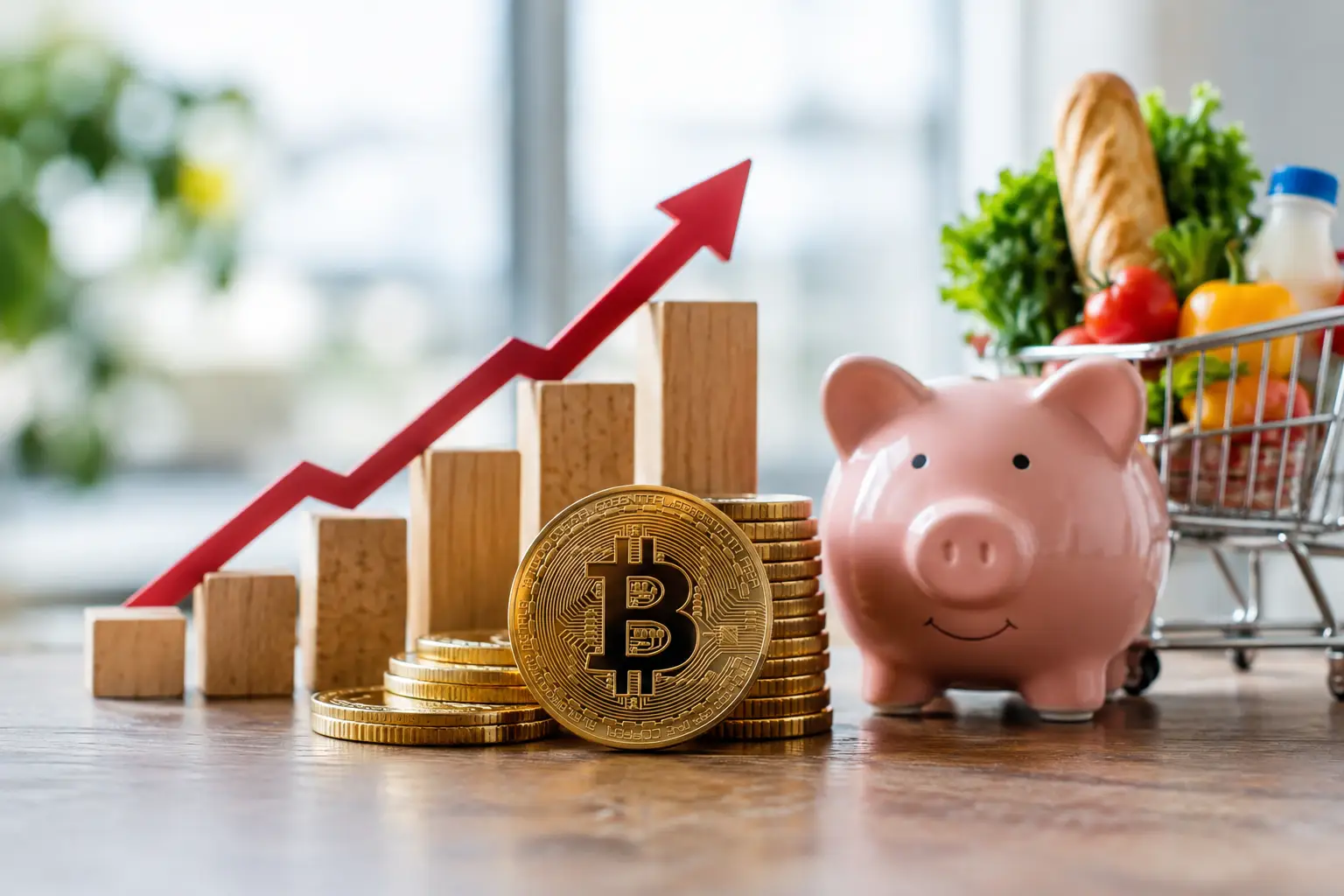
A savings account earning 3% may seem reassuring. But if prices rise faster, your money earns interest while losing purchasing power. This is where the question of bitcoin and inflation savings becomes real: how can you protect part of your capital without turning your daily life into a trading session?
Bitcoin is not a magic solution against all price increases. Its price can rise sharply, but also drop quickly. However, it has a rare feature: its maximum number is capped at 21 million. For a saver thinking over several years, this scarcity deserves to be understood and then integrated methodically.
Inflation and savings: the problem is often invisible
Inflation does not take money from your account. It reduces what that money can buy. Groceries, energy, rent, materials, insurance: when prices rise faster than your savings yield, the gap quietly widens.
Take a capital of 20,000 euros left for several years in a low-yield account. Its displayed amount remains close to 20,000 euros, which gives an impression of stability. Yet, if the cost of living increases, its real purchasing power decreases. You will be able to buy fewer goods and services with the same amount.
This is an issue for both employees saving each month and professionals like plumbers, electricians, landscapers, or mechanics who keep personal cash after a good season. For these professionals, often busy with their work, the challenge is not to track every economic indicator. It is to know where to place savings that are not needed in the short term.
However, two needs must be distinguished. Money set aside for emergencies should remain available and relatively stable. Money invested for the long term can accept more fluctuations, as long as this decision is intentional. Mixing up these two buckets is one of the costliest mistakes.
Bitcoin and inflation savings: what BTC can offer
Bitcoin is a digital asset whose issuance is known in advance. No government, central bank, or company can decide to create more beyond the planned limit. This fixed monetary policy is the main reason why some investors see it as a possible protection against currency depreciation.
When the money supply increases and confidence in a currency declines, Bitcoin’s scarcity can become more attractive. But the key word is “possible.” In the short term, Bitcoin’s price also depends on risk appetite, interest rates, global liquidity, regulations, and investor behavior. It does not mechanically follow the published inflation rate each month.
Scarcity does not eliminate volatility
A limited asset can be volatile. Bitcoin has demonstrated this many times: drops of 30%, 50% or more can occur, even within a positive long-term trend. Someone who buys hoping for immediate protection against inflation may be disappointed if the market drops at the wrong time.
The right approach is not to expect Bitcoin to replace your savings account, your emergency fund, or your salary. Its potential role is rather in a long-term allocation, designed to weather several economic cycles and years of market changes.
Bitcoin does not protect your savings because its price rises every week. It can help diversify savings mainly exposed to the euro, provided you accept that it offers no guaranteed return and can go through tough periods.
Time matters more than timing
Trying to buy at the bottom and sell at the top takes a lot of time, creates stress, and often fails. For an investor with a job, a family, or a business to run, a regular strategy is generally more realistic.
Investing a fixed amount at set intervals helps smooth the purchase price. This approach does not guarantee a profit, but it reduces the pressure of choosing a single “right” moment. It turns an emotional decision into a routine: an amount, a frequency, a duration, and clear rules.
Building savings with Bitcoin without putting yourself at risk
Before buying BTC, start by defining the role of this money. If you need to fund renovations in eight months, pay a tax bill, or replace a business vehicle, this capital should not depend on Bitcoin’s price. Volatility is not a technical detail: it can force you to sell at a loss at the worst time.
A simple structure helps you stay in control. First, keep a reserve available for expenses and emergencies. Then, keep your medium-term projects in vehicles suited to their timeline. Finally, only expose to Bitcoin a portion of capital you can tolerate fluctuating for several years.
The percentage depends on your situation, income, other assets, and especially your real risk tolerance. For some, a small exposure is enough. For others, already convinced and experienced, it will be larger. There is no universal number. A useful allocation is one you can hold without panicking after a significant drop.
Three simple rules before increasing your position
Before each purchase, ask yourself three questions. Is this money available for at least four years? Is my safety reserve already set aside? Could I hold this position if the market lost half its value?
If any answer is no, slowing down is often a better decision than trying to chase a market move. Long-term investing rewards consistency more than urgency.
Security also deserves concrete attention. Use a solution suited to your level, protect your access with strong authentication, and understand where your keys or credentials are stored. A relevant investment loses its value if your bitcoin access is poorly secured. Again, simplicity is better than a complicated setup you do not master.
Reduce the noise to better follow your strategy
The biggest risk for many investors is not just inflation or volatility. It is information overload. A price alert, an alarming message on social media, or a spectacular prediction can be enough to abandon an otherwise coherent plan.
Following a few useful signals is more effective than checking dozens of charts. The evolution of your average purchase price, the share of Bitcoin in your portfolio, your investment horizon, and the main phases of the market cycle already provide a solid overview. They help you see if you are sticking to your strategy, rather than reacting to daily emotions.
This is exactly the benefit of an analysis assistant like Yapuka Holder: centralizing the data that matters, filtering out noise, and making long-term trends easier to read. Artificial intelligence does not decide for you. It saves you time gathering scattered information, so you can make decisions with more perspective.
For a hairdresser, beautician, or renovation entrepreneur, time spent analyzing the market in the evening is not always available. A short, regular routine is more sustainable: check your allocation, note the gap with your goal, and adjust only if something important has changed in your personal situation.
Partial protection, not a promise
Bitcoin can be a relevant tool against monetary erosion, but it should not be presented as a risk-free shelter. It remains young, volatile, and subject to extreme market phases. Its value increases when you place it within a complete strategy: emergency savings, long-term horizon, reasoned purchases, and disciplined monitoring.
Inflation pushes you to think about the future value of your money. Bitcoin invites you to consider scarcity, diversification, and your ability to stick to a plan. The best starting point is not to chase the next price target, but to define a portion of savings you understand, secure, and can hold with peace of mind.