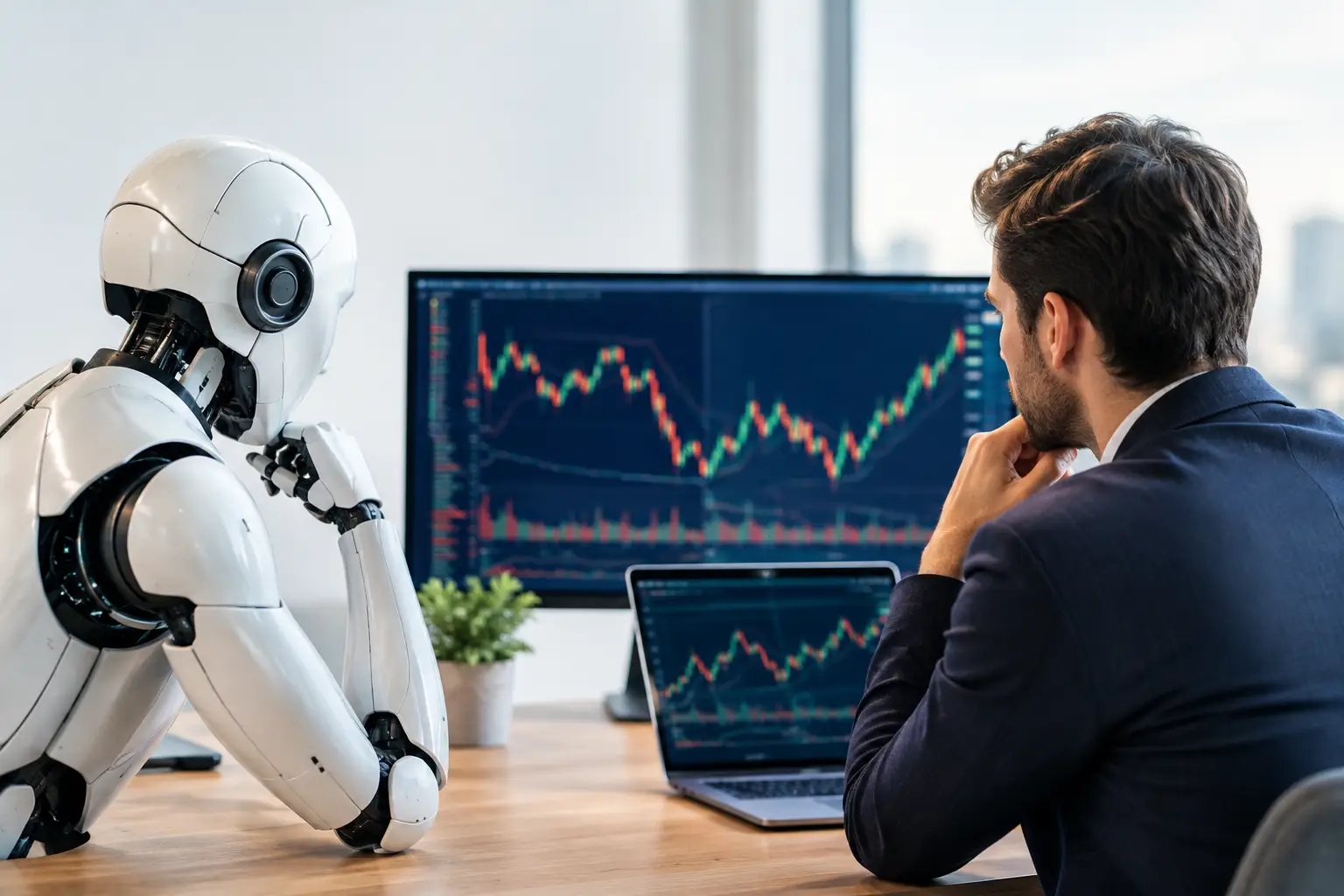
A chart can lose 8% in a few minutes after a macroeconomic announcement, a tweet or a rumor on social media. In this kind of sequence, AI vs human analysis is not just a question of speed: it sets two ways of dealing with uncertainty against each other. One calculates without fatigue and detects regularities in large volumes of data. The other interprets a context, questions a piece of information and decides whether the risk is acceptable.
For an individual trader, the right question is therefore not: “Can AI replace humans?” It is rather: “Which decision should I entrust to the tool, and which responsibility should I keep?” A clear answer helps avoid two costly mistakes: blindly following an automated signal or ignoring useful data out of overconfidence.
AI vs human analysis: two different strengths
Artificial intelligence excels when a task requires going through a lot of information, quickly and consistently. In the markets, it can simultaneously analyze price histories, volumes, technical indicators, volatility changes, order book data or structured news flows. Where a person has to choose what to look at, a model can monitor several assets and timeframes without getting tired.
This ability is particularly useful for spotting situations that would go unnoticed: an unusual acceleration in volume, a divergence between price and momentum, a rise in correlation between two assets, or a change in the volatility regime. AI does not “feel” the market. It identifies statistical signals from the data it is given.
Human analysis brings something else. An investor can link a market move to an exceptional event, assess the quality of a source, question the assumptions of a model and take their own constraints into account. The same bullish signal does not mean the same thing to someone who invests every month, a short-term trader or someone who is already heavily exposed to cryptocurrencies.
Humans are also better placed to judge what is not easily measured. The credibility of a management team, the real scope of a regulation, a change in monetary policy or a geopolitical context can hardly be summed up by a single indicator. These elements do not make AI useless. They are a reminder that numbers must be interpreted before they are turned into a decision.
Speed does not guarantee a better decision
One of the most common arguments in favor of AI is its speed. It is right: an automated system can process an amount of data that is impossible to read manually. But a fast analysis guarantees neither the quality of the data nor the relevance of the conclusion.
If a model is trained on a period dominated by low rates and strong liquidity, it may react poorly in an environment of monetary tightening or financial stress. This is called a market regime change. The statistical relationships observed in the past can degrade, or even reverse. The model may keep producing a seemingly very precise signal, without that signal remaining useful.
The human investor is not immune to this problem. They can be a prisoner of their own experiences: overestimating a strategy that worked recently, believing that a rebound is certain after a drop, or waiting too long because they refuse to admit a mistake. The difference is that a human bias can be discussed and framed. An algorithmic bias must first be identified in the data, the rules or the configuration of the system.
Speed becomes truly useful when it serves a defined process. For example, an automatic alert can signal that an asset is crossing a volatility threshold. It should not, on its own, trigger a position. The trader must still check the context, the level of risk, their investment horizon and the planned exit conditions.
The limits to know before following an AI signal
A market AI is not a crystal ball. It works from historical data, calculation rules and assumptions. Understanding its limits lets you use it with more rigor.
First, data quality is decisive. An indicator built on erroneous, incomplete or outdated data can generate a misleading analysis. In crypto, this risk is reinforced by the fragmentation of platforms, differences in liquidity and some volumes that do not always reflect real economic activity.
Second, there is a risk of overfitting. A model can look excellent in historical tests because it has learned the particularities of the past instead of identifying a lasting relationship. When the market changes, its performance can erode quickly. A good result on an old chart is never proof of future performance.
Finally, any automation can create an illusion of certainty. A 70% probability is not a guarantee. It means that, within a given framework of data and assumptions, one scenario seems more likely than another. In trading, even a statistically sound strategy goes through losing streaks. That is why risk management matters as much as the quality of the signal.
What humans do less well than machines
Recognizing the value of human judgment must not lead to idealizing intuition. Individual traders are exposed to well-known biases: FOMO during a rapid rise, panic during a fall, confirmation bias when they only look for information that supports their position, and loss aversion that makes them hold a struggling asset for too long.
Humans also lack consistency. They can apply a risk management rule one day, then ignore it the next day after three losing trades. They can look at a chart selectively, not keep a trading journal or confuse a rational decision with a decision that simply got lucky.
This is precisely where an automated tool adds the most value. It can apply the same criteria to every asset, keep a history, measure performance and remind you of a rule set in advance. It feels neither euphoria nor frustration. However, it does not know your financial goals, your risk tolerance or the personal consequences of a loss. That part remains human.
A simple method to combine AI and human judgment
The healthiest approach is to split the roles. AI analyzes, filters and alerts. The investor checks, contextualizes and decides. This organization reduces mental load without giving up control.
Start by defining your framework: investment duration, assets followed, maximum amount exposed on a position and acceptable loss. Without these rules, even the best signal cannot determine whether it suits your situation. A short-term signal on Bitcoin is not as useful to a swing trader as it is to someone building a gradual exposure over several years.
Then use AI to narrow down the field of possibilities. Instead of monitoring twenty charts, you can ask the tool to surface the assets with a volume anomaly, a technical breakout or an unusual change in market sentiment. The goal is not to receive a ready-to-execute buy or sell order. It is to know where to focus your attention.
Before any decision, ask three simple questions. What is the exact signal? What data supports it? What would invalidate this scenario? If you cannot answer the last question, the position is probably too vague. Defining an invalidation level does not predict the market, but it avoids turning a hypothesis into a rigid conviction.
Finally, document your decisions. Note the signal observed, the context, the level of risk and the result. After several weeks or several months, this journal lets you tell a repeatable method from a series of coincidences. It is also the best way to improve how you use an AI tool: not by taking its word for it, but by assessing its contribution to your own process.
A decision aid, not an autopilot
The opposition between human analysis and artificial intelligence is often poorly framed. AI is very good at organizing information, monitoring markets, spotting anomalies and applying rules with discipline. Humans remain necessary to give meaning to the data, set the goals and accept or refuse a risk.
An AI agent or an automated tool such as those used on a market intelligence platform can help you analyze more data, detect the signals that deserve your attention and save time in your preparation. It can also lighten the mental load by structuring your monitoring and limiting decisions made in a hurry. But it guarantees neither gains nor protection against losses: the final decision must remain based on your strategy, your understanding and appropriate risk management.