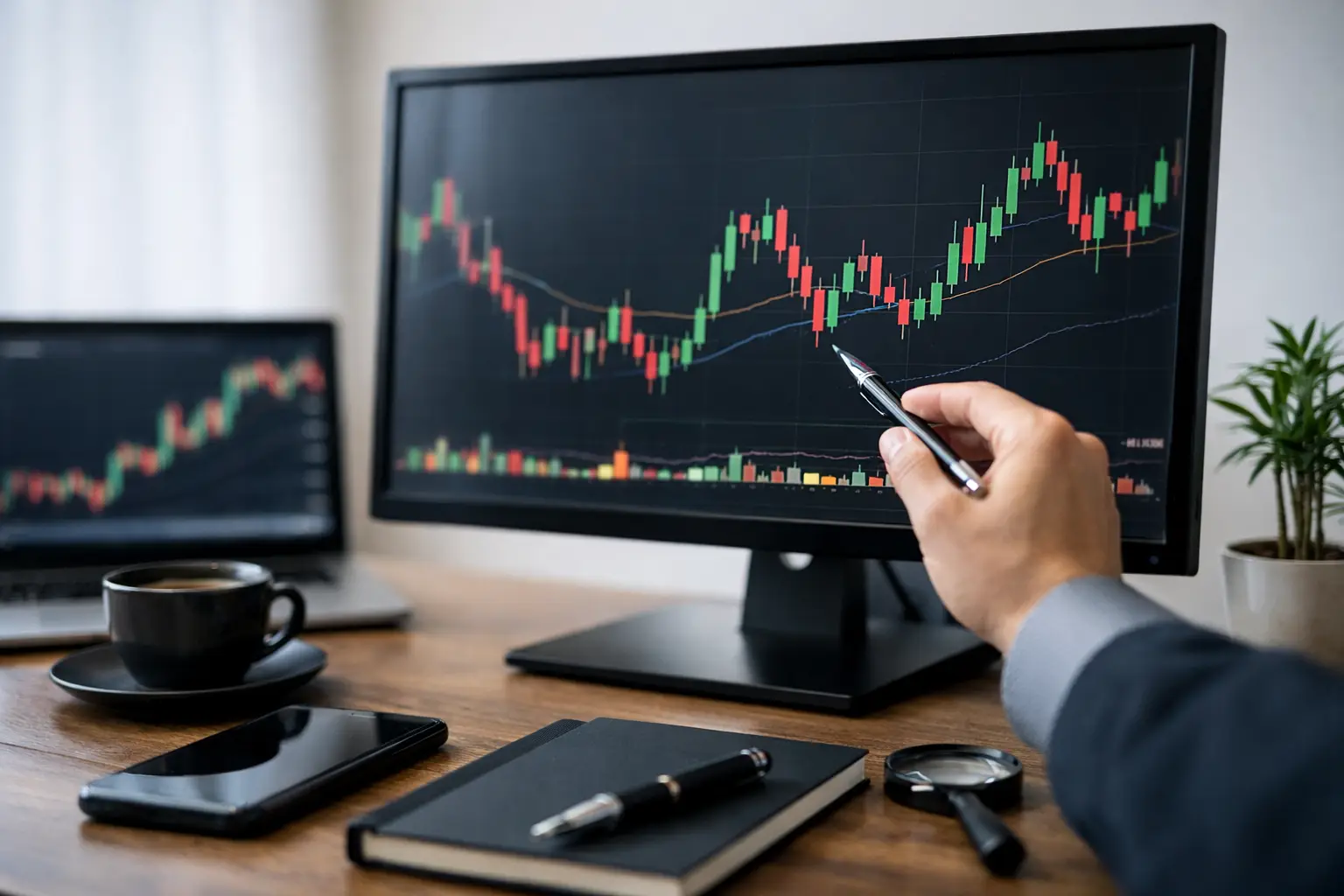
A trader who looks at a chart without understanding candles sees noise. A trained investor begins to read a story. This is precisely where knowing how to use Japanese candlesticks trading becomes useful: not to guess the future, but to better interpret the balance of power between buyers and sellers.
In the crypto market, this reading is even more valuable. Movements are rapid, false signals are frequent, and emotion often leads to entering too early or leaving too late. Japanese candlesticks provide a simple visual language, but their true value only appears when placed in the context of trend, market structure and technical level.
Why use Japanese candlesticks trading
A Japanese candlestick summarizes, over a given unit of time, four essential information: the opening price, the highest, the lowest and the closing price. In other words, a single candle shows you where the market started, how far it went up or down, and most importantly where it ended.
It is this last point that matters enormously. A strong close near the highs does not have the same meaning as a candle that ends in the middle of its range. Visually, this gives you clues about whether the market is convinced, whether a level has been rejected, or whether a movement is running out of steam.
But we must be clear: candlesticks are not magic signals. An isolated reversal pattern isn’t worth much if it appears in the middle of nowhere. On the other hand, the same pattern near a major support, after a strong bearish impulse, can become much more interesting.
The basics to understand before using candles
Before looking for complicated names, you must master the simple reading of a candle. The body represents the gap between the open and the close. The highlights show the extremes reached during the period. The wider the body, the more assertive the movement. The longer the strands, the more there was a fight or rejection.
A wide bullish candle often reflects buyer dominance during the period. A wide bearish candle indicates the opposite. A small candle with long wicks suggests hesitation, or even an area where the market is looking for direction.
This is often where beginners go wrong. They learn ten figures by heart, but do not know how to answer a simple question: who has really taken the advantage in this price zone? As long as this logic is not acquired, the names of the patterns are of little use.
The role of the unit of time
The same candle does not have the same range over 5 minutes, 1 hour or 1 week. On a small unit, it may simply reflect noise or intraday volatility. On a higher unit, it sometimes reflects a real change in the market balance.
If you invest or swing trade in crypto, units like 4H, daily or weekly are often more readable. They filter out some of the noise. Conversely, if you only focus on very short-term candles, you risk overinterpreting unimportant movements.
The most useful Japanese candlesticks in trading
It is not necessary to know fifty. A few well-understood configurations are more than enough to progress.
The hammer, first of all, shows a long, low bit with a smaller body. It suggests a rejection of lower prices. Taken alone, this is not a purchase order. But if it appears on support, after a decline, with confirmation on the next candle, it can signal a resumption of buying interest.
The shooting star works in the opposite logic. A long, high wick reflects a rejection of higher prices. In a resistance zone or after a bullish extension, it can indicate a weakening of the buying camp.
Bullish or bearish engulfment is also closely monitored. When the body of one candle encompasses that of the previous one, this reflects a clearer takeover of one camp over the other. Here again, context makes the difference. A bullish engulfment in the middle of a consolidation does not carry the same weight as a bullish engulfment on a key support.
The doji, finally, attracts a lot of attention because it shows a form of balance between opening and closing. But a doji does not automatically mean reversal. Above all, it indicates hesitation. So you have to look at what happens before and after.
How to use Japanese candlesticks trading without falling into the traps
The first reflex to adopt is to never read a candle alone. A candle has meaning when it fits into a sequence. Always ask yourself what happened before. Was there a strong impulse? A recent breakout? A test of support or resistance? A liquidity zone swept away?
The second reflex is to wait for confirmation. Many errors come from anticipating a signal before the close. In crypto, a candle can look very bullish for a few minutes then completely reverse before it closes. As long as the period has not ended, the signal is not validated.
The third point is to integrate the market structure. A nice bullish pattern against an intact downtrend remains a risky counterpoint. Conversely, a simple continuation candle in a clear trend can offer a cleaner signal than a spectacular but isolated pattern.
What to combine with candlesticks
Candlesticks are most effective when combined with other simple benchmarks: supports and resistances, trends, retests, and volumes if you use them. You do not need to stack indicators. Above all, you need consistency.
For example, a hammer that forms on daily support after a hunt for liquidity below the level is much more interesting than a random hammer. Likewise, a bearish swallow below resistance, after a false breakout, tells something much more exploitable.
It is this overall reading that allows us to move from a decorative analysis to a useful analysis. At Cryptos Formation Continue, it is precisely this structured approach that makes the difference: learning to read a chart as a system, not as a collection of disconnected signals.
A simple method to progress quickly
Start by looking at a single market and a single primary unit of time. The goal is not to see everything everywhere, but to develop your eye. Then take three or four candle configurations maximum and note their context each time: trend, key level, type of reaction, result after confirmation.
After a few dozen examples, you will see very useful nuances appear. Some figures work better in trend than in range. Others give a lot of false signals during times of news or excessive volatility. It is this observational work that builds real benchmarks.
You can also take before and after screenshots. This habit is underestimated. It allows you to check whether you have read the situation correctly or whether you have projected what you wanted to see.
What candlesticks will never do for you
Candles will not replace risk management, patience, or a clear plan. Many traders know how to recognize a hammer or a swallow, but still lose money because they oversize their positions or take impulsive trades.
We must accept a simple reality: a candlestick sometimes increases a probability, it never offers certainty. Even a very nice setup can fail. This is why a good trader thinks in scenarios, not in promises.
In the crypto market, this discipline is even more important. Volatility can quickly invalidate a correct setup. If your reading of candlesticks is not framed by a clear invalidation level and serious risk management, you are transforming an analysis tool into an excuse to enter randomly.
Use Japanese candlesticks trading with more maturity
The real milestone to take is not to learn tricks. It’s understanding what they reveal about market behavior. A long lock is not just a visual shape. It is often the trace of a rejection, a trap or an absorption. A great body isn’t just an awesome candle. This is sometimes proof of a clear imbalance between supply and demand.
When you start seeing candlesticks this way, your reading changes. You stop looking for automatic recipes. You develop a more calm, more precise analysis, and above all more compatible with a market as demanding as crypto.
If you’re just starting out, keep it simple. Learn to read a candle, then a sequence of candles, then their place in the overall structure. It’s less spectacular than collecting exotic patterns, but it’s much more useful over time.
Japanese candlesticks won’t tell you what to do at every moment. On the other hand, they can teach you to listen better to the market before acting.