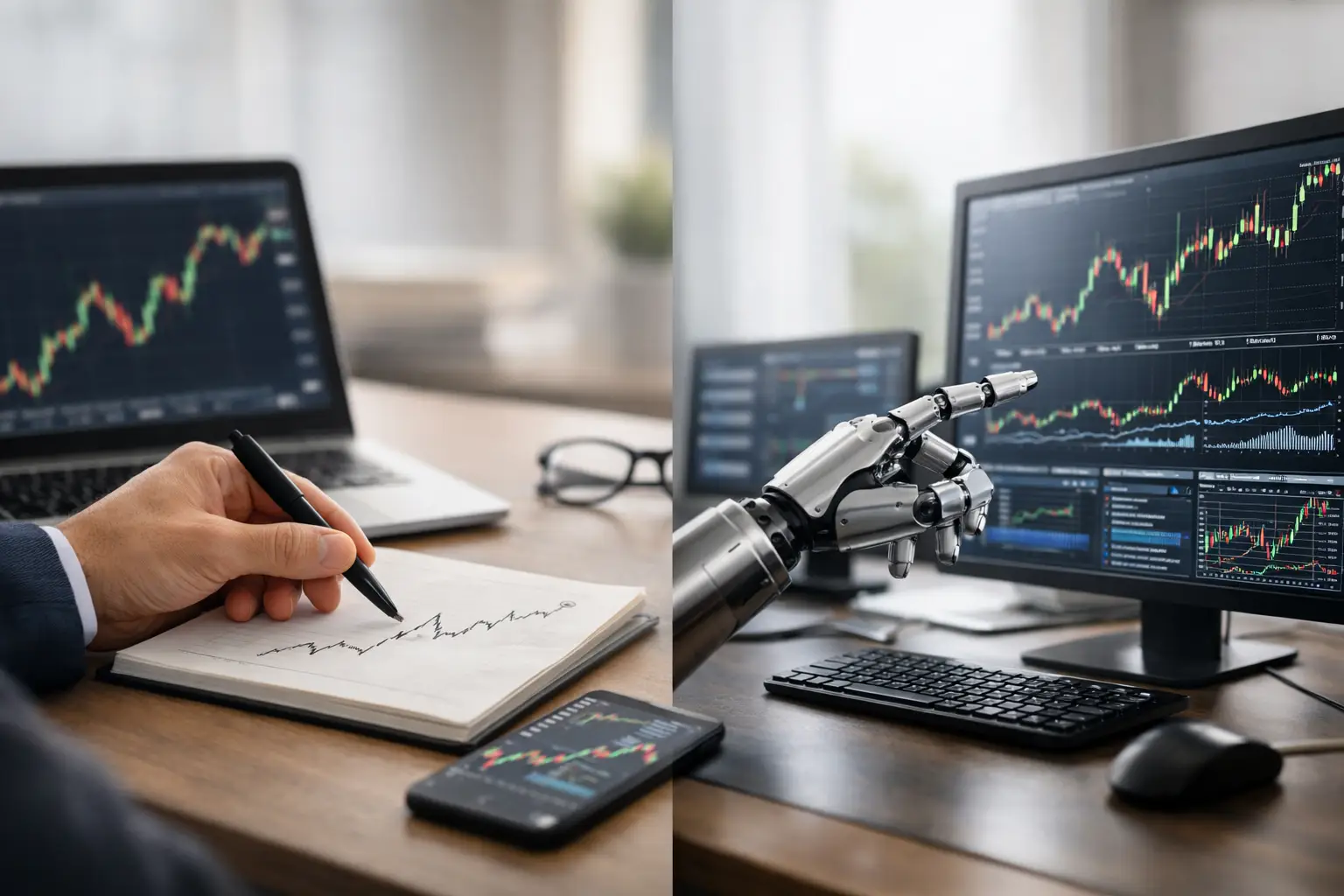
A signal appears at 2 a.m. on the crypto market. Should you get up, check the chart, and place an order? Or let a pre-programmed rule act on your behalf? When it comes to choosing between manual or automated trading, there is no universally superior method. The real question is about aligning your availability, experience, risk tolerance, and the strategy you can actually apply with discipline.
Automation is appealing because it promises to remove emotion and save time. Manual trading is reassuring because it keeps control in the investor’s hands. Yet, in both cases, mistakes rarely come from the tool itself. They stem from vague rules, unrealistic expectations, or poorly calibrated risk.
Manual vs Automated Trading: The Real Difference
Manual trading involves analyzing the market and making every decision yourself: buying, selling, position size, stop level, or taking profits. The trader may rely on technical analysis, macroeconomic data, news, volumes, or their own trading plan. This approach offers great adaptability, but requires you to be present, focused, and able to stick to your rules when the market becomes unstable.
Automated trading executes instructions set in advance. These can be simple—like buying an asset when its price crosses above a moving average—or more complex, involving multiple indicators, volatility filters, and risk management rules. Automation can take the form of conditional orders, a bot, a script, or a more advanced system connected to a brokerage or exchange platform.
The key difference is not that one “thinks” and the other “acts.” An automated system has no financial judgment by default. It simply applies the rules you give it, quickly and tirelessly. If those rules are weak, incomplete, or poorly tested, it will repeat those flaws with remarkable consistency.
The Strengths and Limits of Manual Trading
The main advantage of manual trading is context. A human investor can spot exceptional events: a central bank announcement, a security incident on a cryptocurrency, a liquidity crunch, economic releases, or unusual sector moves. They may decide not to act when a technical signal looks good on paper but occurs in an uncertain market environment.
This flexibility is useful for discretionary strategies and markets influenced by news. It also helps beginners understand the link between a hypothesis, a decision, and its outcome. Observing your own reactions to a loss or a missed opportunity is part of the learning process.
The downside is emotional. Fear can push you to close a position too early. Euphoria may encourage you to increase a position without justification. Confirmation bias sometimes leads you to seek only information that supports an existing opinion. Even with a solid plan, staying disciplined after several consecutive losses takes practice.
Manual trading also requires time. Monitoring multiple assets, watching for announcements, and checking key levels can be hard to balance with a job or family life. This isn’t a moral failing—it’s a practical constraint to consider when choosing your method.
What Automation Really Brings
An automated strategy first brings consistency. Once the rules are set, execution no longer depends on your mood, fatigue, or availability. The system can monitor multiple markets simultaneously and act at any hour, which is especially relevant for continuously open markets like cryptocurrencies.
It also forces you to formalize an idea. Instead of saying “I buy when the trend is good,” you must define what a trend means: which indicator, which timeframe, what threshold, what position size, what stop-loss, what exit condition? This precision is valuable, even if you ultimately choose to trade manually.
Finally, automation makes historical testing easier. Testing a rule over several years of data can help measure its trigger frequency, drawdowns, and behavior in different market regimes. A backtest is not proof of future performance, but it’s often a useful filter before risking real capital.
However, automation does not guarantee reliability. A bot can face connection issues, poor API configuration, underestimated transaction fees, or lack of liquidity. In some markets, the gap between theoretical and actual execution price—called slippage—can significantly affect results. A strategy that looks profitable in a spreadsheet may disappoint when faced with real costs and conditions.
The Trap of the Too-Perfect Backtest
The most common risk is overfitting. This happens when a strategy is excessively adjusted to fit past data. It then appears excellent because it adapts to every historical detail, but those details may not repeat.
To reduce this risk, test a strategy on different periods and keep some data for independent validation. Include fees, execution delays, and conservative assumptions about slippage. Before going live, observe the system’s behavior in a demo account or with a small position size.
How to Choose an Approach That Fits Your Profile
The right question isn’t “which system makes the most money?” No one can honestly answer that without knowing the market, investment horizon, risk taken, and future conditions. Instead, ask yourself which method lets you follow a clear process for several months.
Manual trading is better suited if you want to learn to read markets, have time to analyze your decisions, and your strategy depends heavily on context. It may also be preferable when you trade infrequently, for example over several days or weeks. In this case, automating every decision isn’t always necessary.
Automation becomes attractive when your rules are repeatable, objectively defined, and applied to multiple assets or time slots. It can suit an investor who can’t monitor markets during the day, provided they master risk parameters and regularly check the system.
Before choosing, assess four elements: the time you can devote to monitoring, your ability to write precise rules, your technical understanding of the tools, and the amount you’re willing to risk. If any of these is weak, simplify your approach rather than seeking a more sophisticated system.
The Hybrid Approach Is Often the Most Realistic
Setting human and machine in opposition hides a third way, often more suitable for individual traders. A hybrid approach automates repetitive tasks while keeping human validation for important decisions.
You can, for example, receive an alert when an asset crosses a defined level, use stop orders to limit risk, or set up periodic purchases on a schedule. You retain control over allocation and context, while the tool reduces the risk of forgetting a rule or missing a signal.
This method lets you progress without blindly delegating your capital. It’s especially useful for beginners: before entrusting a strategy to a bot, it’s better to follow it manually long enough to understand its strengths, limits, and when it doesn’t work.
Risk Management Remains Non-Negotiable
Whether manual or automated, no system protects you from loss without explicit risk management. Define in advance the portion of capital you’re willing to risk per position, the level at which your hypothesis is invalid, and the maximum acceptable loss over a given period.
Avoid confusing frequency with diversification. A bot that executes many orders on highly correlated cryptocurrencies may concentrate risk instead of spreading it. Likewise, adding more indicators doesn’t guarantee better decisions if they all react to the same price movement.
Operational security matters too. Limit API key permissions, disable withdrawals when possible, enable two-factor authentication, and regularly check activity logs. Automation doesn’t remove your responsibility to monitor.
Using AI to Structure Your Decisions
An AI or AI agent can help make your approach more methodical, without taking your place or promising results. It can analyze large amounts of data, synthesize market information, spot unusual variations, compare scenarios, or alert you when your criteria are met. Tools like Yapuka Trader can also reduce the time spent on monitoring and make it easier to read complex signals.
The key is to turn this information into understandable rules, suited to your capital, and tested over time. AI can lighten your mental load and clarify a decision, but it never guarantees profits. Your lasting edge comes from a controlled process: understanding what you automate, knowing why you act, and accepting that risk is always part of investing.