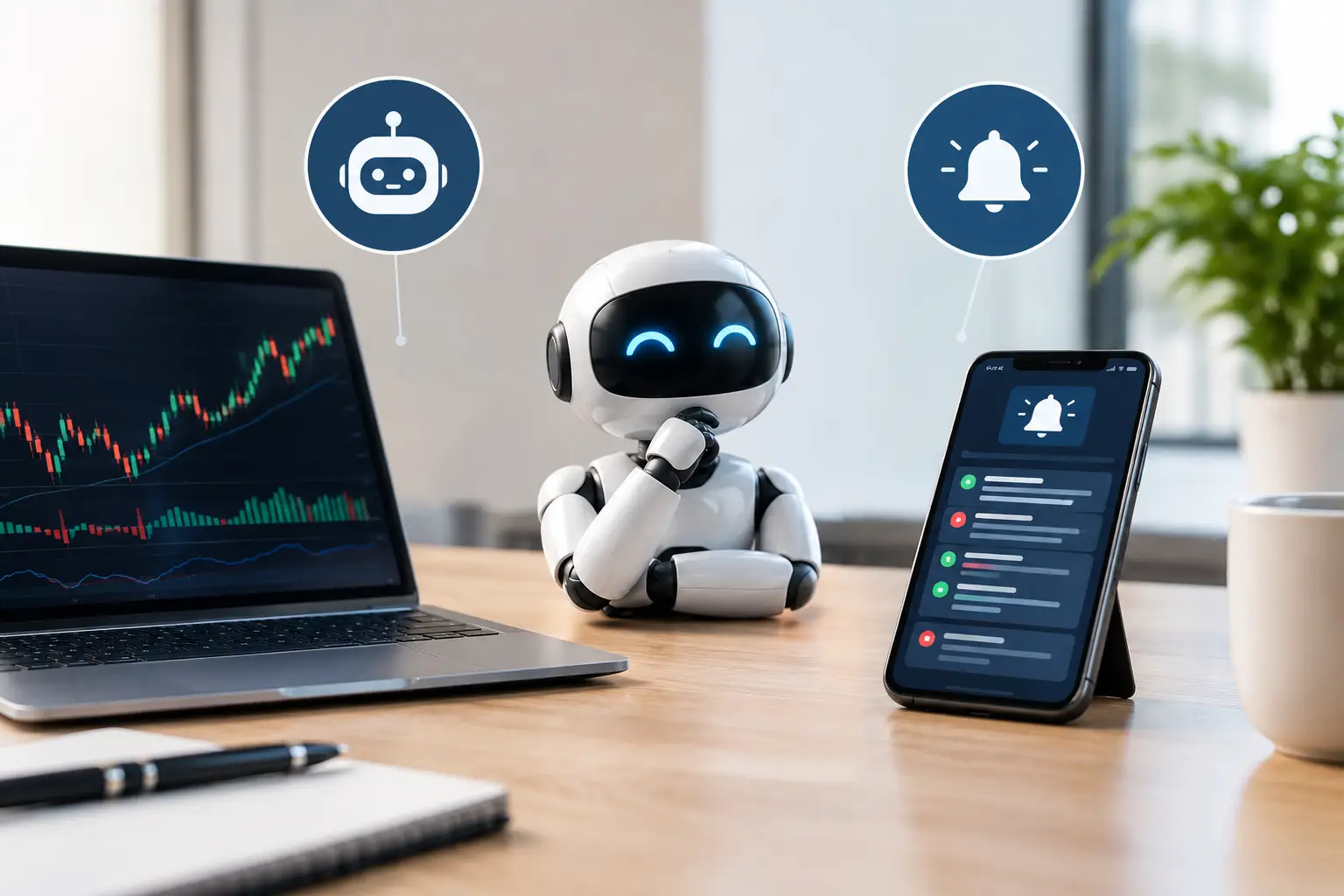
An order executed at 3 a.m. may seem appealing. However, between trading robots or alerts, the best option isn’t the one that promises the most automation. It’s the one you understand, can monitor, and that matches your availability, method, and risk tolerance. A tool does not turn a fragile strategy into a profitable one.
For a retail trader, the question deserves to be asked precisely. The robot acts on your behalf according to programmed rules. An alert, on the other hand, notifies you when a market condition is met and lets you decide. This difference changes the level of control, mental load, and possible errors.
What a Trading Robot Actually Does
A trading robot, also called a bot or algorithm, automatically executes predefined actions. For example, it can buy bitcoin if a short moving average crosses above a long one, set a stop-loss, and then sell at a set target. Its main advantage is mechanical discipline: it feels neither fear during a drop nor euphoria after a rapid rise.
This discipline, however, comes with a trade-off. The robot applies rules, not common sense. If market conditions change suddenly, it may not understand that an economic announcement, a platform outage, or unusually low liquidity alters the context. It continues to execute the planned scenario, unless that scenario specifically includes such protections.
A robot can be relevant when the strategy is clear, tested, and repeatable. This is often the case for simple trend-following rules, portfolio rebalancing, or split order execution. It is much less suited to a vague idea like “buying the best cryptos at the right time.” Behind such promises, there is usually no verifiable rule.
Automate a Rule, Not an Intuition
Automation works best when every decision can be written unambiguously: which asset to follow, on which timeframe, at what entry price, what position size to take, when to exit, and when not to trade. If you can’t define these elements clearly, a robot risks only automating uncertainty.
Position sizing is especially important. A good signal with excessive exposure can lead to a loss that’s hard to absorb. Before handing execution to a program, you must set a maximum risk per trade, a daily maximum loss, and an exposure limit per asset. These safeguards often matter more than the indicator chosen.
Alerts Keep the Human in the Loop
An alert notifies you when a price reaches a level, volume accelerates, an indicator crosses a threshold, or a defined event occurs. It does not place orders for you. You receive the information, then review the chart, the context, and your plan before acting.
For beginner or intermediate investors, this approach offers a major educational advantage: it forces you to connect a signal to a decision. You gradually learn to distinguish a credible breakout from a simple volatile move, or a normal dip from a deeper trend change. The time saved doesn’t come from a lack of thinking, but from no longer needing to watch screens constantly.
Alerts are not without limits. They can become counterproductive if too numerous. Ten notifications a day easily create a sense of urgency and encourage overtrading. An alert should correspond to a specific question: “Does this level deserve analysis?”—not an injunction: “You must buy now.”
A Useful Alert Triggers a Check
Before taking any position, check at least three elements: the underlying trend, the accepted risk level, and the asset’s liquidity. For less capitalized cryptocurrencies, a price move can be spectacular without offering good entry or exit conditions. A technical signal does not erase fees, spreads, or execution risk.
This step is also an opportunity to consult an event calendar and check if the move is confirmed by volume. An alert can signal a resistance breakout. It cannot, by itself, establish that the market will hold this level after an announcement or during a period of low activity.
Trading Robots or Alerts: The Right Choice for Your Profile
The choice depends less on your appetite for technology than on your level of preparation. If you are still building your method, alerts are generally a better starting point. They reduce monitoring time while preserving your analytical ability. They also allow you to document your decisions and identify recurring mistakes.
A robot becomes more coherent when you have already gathered data on your strategy. You must know how it behaves in bull, bear, and sideways markets. You should also know its win rate, average gain, average loss, and potential losing streak. Without these benchmarks, a positive result over a few weeks is not proof of reliability.
The hybrid mode suits many independent traders. The system detects setups and sends alerts. The investor then validates the order or automates only certain low-value tasks, such as placing a stop-loss, partial profit-taking, or periodic rebalancing. This setup keeps the human responsible for important choices.
Commonly Underestimated Risks of Automation
The first risk is overfitting. A strategy may seem excellent when tested on past data because it was tuned to fit that past almost perfectly. As soon as the market changes, its results deteriorate. Seeking “perfect” parameters is often a red flag, not a sign of quality.
The second risk is operational. An unprotected API key, a misconfigured bot, a lost connection, or a duplicated order can have real consequences. You should choose limited permissions, disable withdrawals when possible, monitor activity logs, and test the solution with reduced exposure.
The third risk is psychological. Automation can give the impression that risk disappears because decisions are made by a system. In reality, you’ve simply shifted the decision: it was made when programming the rules. You remain responsible for the capital committed, the chosen strategy, and its monitoring.
A Cautious Method to Get Started
Start by defining a single market setup, rather than seeking a system that can trade everything. Write your plan in plain language: entry condition, invalidation, possible target, position size, and maximum holding time. Then, use alerts on this setup for several weeks and record each reaction in a journal.
When you have enough history, look at the numbers rather than your memories. How many signals were actually usable? What was the impact of fees? When did you ignore your own rule? This phase is useful even if you never want to fully automate your trading.
If you then move to a robot, start in simulation or with limited capital. Don’t change parameters after every losing streak. Set in advance the criteria that would justify a pause, a review, or stopping the system. A serious strategy accepts that it may go through unfavorable periods.
An analysis platform like Yapuka Trader can help centralize this process: trend tracking, signal detection, data analysis, and context setting. The goal is not to blindly delegate your decisions, but to have more structured information to make them.
AI, an AI agent, or an automated tool can thus spot unusual moves, filter hundreds of signals, and reduce the mental load of market monitoring. Used with clear rules, it saves you time and makes your decisions more consistent. It does not predict the future or guarantee any profit: risk management, understanding your strategy, and final control remain in your hands.