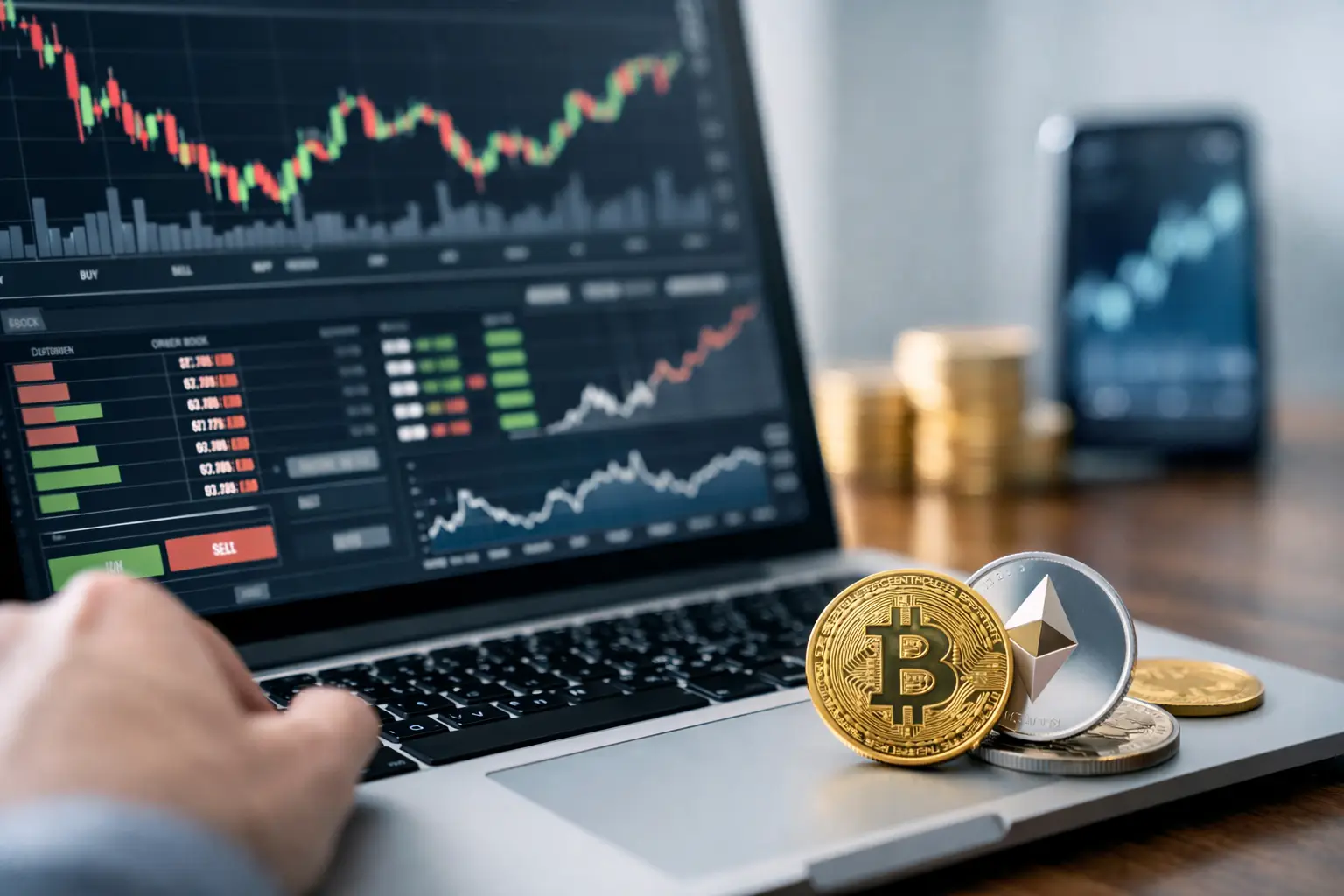
Buying too early, missing an entry by a few cents, seeing an order go higher than expected – this is often when we realize that buying “at the market” is not always the right tool. To understand crypto limit order, you have to start with a simple reflex: define your price before entering, instead of letting the market decide for you.
The limit order is one of the basics that every crypto investor should know. This is not a tool reserved for experienced traders. On the contrary, it often helps beginners to regain control over their execution, provided they understand what it really does, and especially what it does not do.
Understanding crypto limit order: the useful definition
A limit order is a buy or sell order placed at a specific price, chosen in advance. If you want to buy an asset for 40,000 euros maximum, you place a buy limit order at 40,000 euros. If the market reaches this level and there is enough liquidity, the order can be executed. If the price never touches this level, it remains pending or expires depending on the chosen parameters.
For a sale, the principle is identical. You indicate the minimum price at which you agree to sell. Again, the market must come to this level for the order to place.
The essential nuance is this: a limit order controls the price, but does not guarantee execution. This is the point that many beginners discover after the fact. They see their level being “almost touched”, then the market leaves without them. This is not necessarily a platform error. It is often a question of liquidity, spread or time spent on the level.
Why limit order changes the way you buy
When you use a market order, you favor certainty of execution. You accept the best price available at the time. It’s convenient, fast, but sometimes expensive if the market moves quickly or if the order book is shallow.
With a limit order, you do the opposite. You favor price control. It changes your mental posture. You are no longer in the reaction, but in the preparation. You decide in advance where your storyline remains consistent.
For an individual investor, this difference is important. It reduces impulsive decisions. It also forces you to ask a useful question before acting: at what price am I really ready to buy or sell, and why?
How a limit order works on a crypto platform
Most platforms ask for three elements: asset, quantity and limit price. Once the order is validated, it joins the order book. He waits for a counterparty to accept this price.
Let’s imagine that a bitcoin costs 42,000 euros. If you believe that a more attractive area is at 41,200 euros, you can place a buy limit order at this level. As long as the market stays above, nothing happens. If the price drops to 41,200 euros, your order potentially becomes executable.
The word “potentially” matters. If many buyers are already positioned at this price before you, or if the market crosses the level very quickly, execution may be partial or non-existent. On large, highly liquid cryptos, this problem is generally more limited. On less traded altcoins, it becomes much more common.
Buy limit order
The buy limit order is used to not pay more than a certain price. It is often used to buy a pullback, enter support, or build a position gradually.
Sell limit order
The sell limit order is used to not sell below acertain price. It can allow you to take profits on a target area, without having to constantly monitor the screen.
Real benefits, without fantasy
The first advantage is control. You know exactly what price you are aiming for. It sounds simple, but in a market as volatile as crypto, this discipline makes a real difference.
The second advantage is the reduction of slippage, that is to say the gap between the expected price and the price actually obtained. In turbulent markets, this gap can quickly weigh on performance, especially if you multiply entries and exits.
The third advantage is organizational. A limit order allows you to prepare your scenarios in advance. You can set multiple levels, calibrate your position sizes and avoid trading under pressure.
Finally, there is an often underestimated benefit: clarity. A limit order requires you to be more precise. This precision often improves risk management, because it fits more easily into an overall plan.
Limits to know before using it
The limit order is not “best” in all cases. It’s best when price matters more than speed.
Its main flaw is obvious: you may not be executed. In a fast bull market, waiting for an ideal price can leave you left behind. It’s frustrating, but it’s not necessarily negative. Sometimes the market just doesn’t give you your entry point.
Another limit is partial execution. You place an order for 1 ETH, but only 0.4 ETH is purchased at the asking price. The rest can remain pending. This makes it difficult to manage if you’re not careful.
The spread must also be taken into account. On some platforms or assets, the best bid price and the best ask price do not coincide. As a result, you may believe that the level was touched even though your order was not really executable.
Understanding crypto limit order versus market order
The true comparison does not pit a good order against a bad order. It opposes two different priorities.
The market order is useful if you need to enter or exit immediately, for example in a very liquid context where a few euros difference has little impact. Above all, it guarantees speed.
The limit order is best suited if you have a precise level, defined entry logic and the patience to wait. It is often best for beginning investors who want to reduce emotional mistakes.
In practice, many use both depending on the context. An investor can build a position with limit orders and then use a market order to quickly adjust as needed. It all depends on the asset, liquidity and your time horizon.
The most common mistakes beginners make
The first mistake is placing a limit order “randomly” simply because the price seems lower. A level must have logic. Graphical support, value zone, psychological price, technical level observed on history: you need a reason.
The second mistake is forgetting position size. A good price does not erase bad sizing. Even with a limit order, a crypto asset remains volatile. If the position is too big, the stress returns immediately.
The third mistake is confusing limit and stop orders. A limit order seeks a favorable execution price. A stop is rather used to trigger an exit or entry when the market crosses a certain threshold. Mixing the two can create real misunderstandings.
Finally, many start without looking at liquidity. On a thinly traded asset, your theoretical price may be worthless in practice. The order book, volume and market depth remain essential benchmarks.
In which cases the orderlimit is particularly useful
If you invest gradually, the limit order is very relevant. It allows you to spread your purchases over several levels instead of doing everything at once. This approach limits the impact of a bad one-off entry.
It is also useful if you have a simple method based on technical areas. For example, buying a crypto on a pullback near an identified support, or selling part of the position on a clear resistance.
On the other hand, if you intervene on an important announcement or on a very nervous market, the limit order may be less suitable. The price can jump from one level to another without serving you properly. In these phases, we must accept that the quality of execution depends a lot on the context.
A more disciplined approach to crypto
Understanding the limit order in crypto is not just about learning an interface button. It’s adopting a more structured way of taking a position. You define your entry conditions, you accept that certain opportunities escape you, and you avoid transforming each market movement into an urgent decision.
This logic is particularly useful for self-directed investors who want to progress without overloading their attention. The clearer your method, the less you depend on the emotion of the moment.
This is also where an AI-powered analytics tool can become interesting. It can help spot consistent price zones, read liquidity, track technical levels, detect less visible signals and organize your scenarios faster. Platforms like Yapuka Trader can alleviate this data analysis and sorting work. The important thing remains the same: AI does not buy for you and does not guarantee any gains, but it can help you decide with more method, less mental noise and a clearer reading of the market.