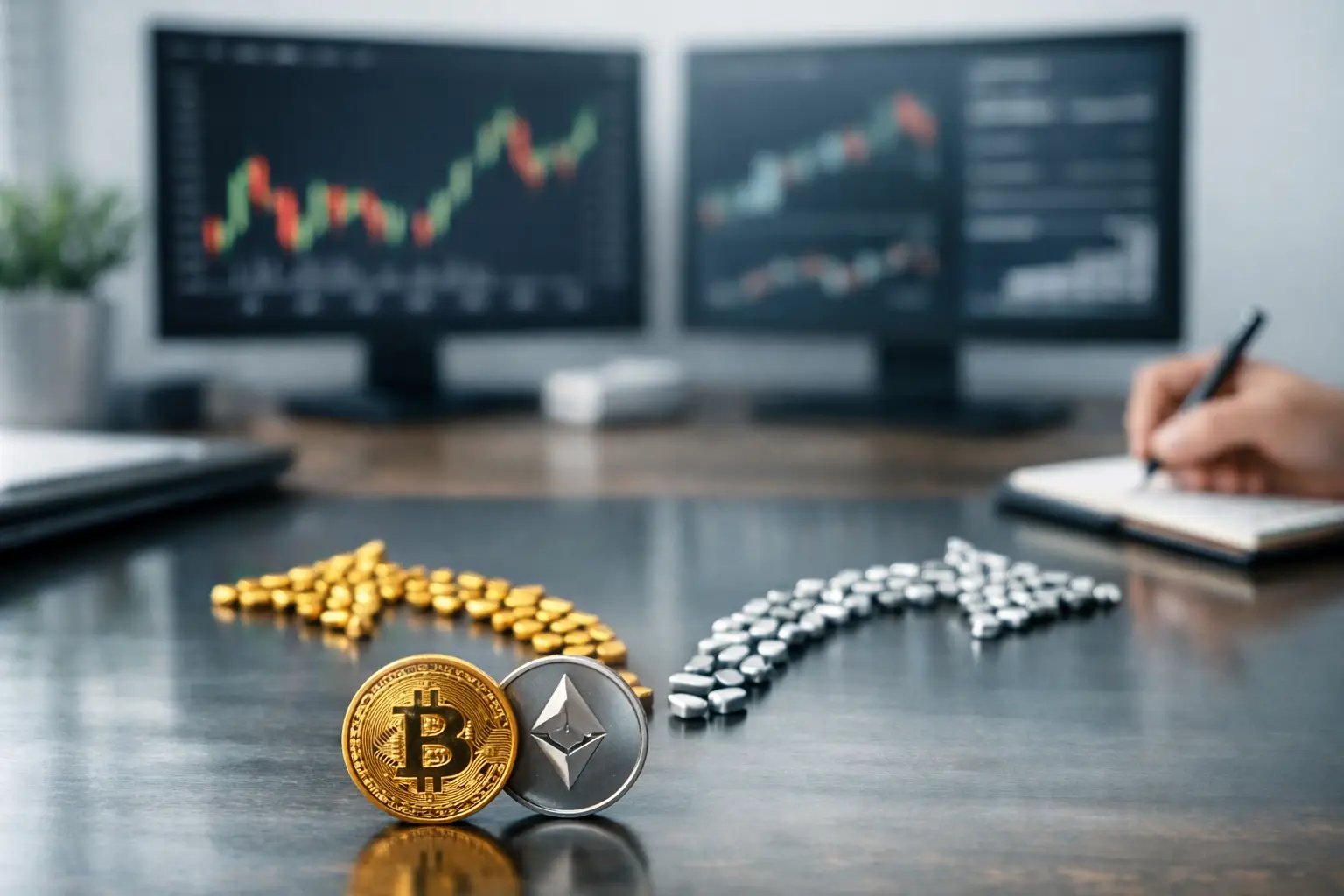
Buying bitcoin on the spot market and taking a leveraged position on ether serve different needs. Behind the question “crypto spot or futures” lie two very different ways to gain market exposure, each with its own rules, costs, and risks. The right choice doesn’t depend on a promise of returns, but on your investment horizon, experience, and ability to handle a loss.
Crypto Spot or Futures: The Key Difference
The spot market, also called the cash market, involves buying or selling an asset immediately at the displayed price. If you buy 1,000 euros worth of bitcoin on the spot market, you actually own the equivalent in bitcoin in your account. Its value then fluctuates with the price. You can hold it, transfer it to a personal wallet, or sell it later.
Futures, or forward contracts, are different. You don’t necessarily own the cryptocurrency itself. You open a contract that tracks its price, whether up or down. On most crypto platforms, retail traders use perpetual contracts, which have no expiration date but whose price remains aligned with the spot market through a funding mechanism.
This distinction has a direct consequence: spot naturally suits a buy-and-hold approach, while futures are designed for trading exposure. Both can coexist in a strategy, but they should not be confused.
Spot: Simple Exposure, But Not Without Risk
The main advantage of spot is its clarity. You commit only the capital you own, and your maximum loss—barring exceptional cases like platform bankruptcy or custody issues—is the amount invested. A spot position cannot be automatically liquidated just because the market drops by 5%, 10%, or 30%.
Let’s take a simple example. You buy 500 euros worth of solana on the spot market. If its price drops by 20%, your position is worth about 400 euros. The loss isn’t pleasant, but you keep your tokens and can wait for a potential recovery, as long as your investment thesis remains valid.
This apparent simplicity doesn’t mean you can skip having a method. Spot fully exposes you to crypto volatility and can encourage emotional decisions: buying after a big rally, panic selling, or concentrating too much capital in a single asset. Holding the asset doesn’t guarantee its quality or longevity.
Spot is generally better suited for beginners who want to learn how the market works, build a position gradually, or invest with a longer-term horizon of several months. It mainly requires knowing how to select assets, define an allocation, and secure the custody of your funds.
Limitations of the Spot Market
On the spot market, it’s harder to profit from a decline. Some platforms allow short selling via borrowing, but this adds fees, constraints, and risks. In practice, many spot investors prefer to reduce exposure, hold cash, or wait rather than actively bet against the market.
The capital required is also higher. To gain exposure to 2,000 euros worth of bitcoin, you need about 2,000 euros. This constraint may seem frustrating, but it also acts as a safeguard against oversized positions.
Crypto Futures: Flexibility and Amplified Risk
Futures allow you to take a long position if you expect a rise, or a short position if you expect a drop. They also provide access to leverage. With 5x leverage, a 200-euro deposit can control a 1,000-euro exposure. This is precisely what makes them attractive—and dangerous.
Leverage doesn’t create better analysis. It simply amplifies the effect of a price move. If a 1,000-euro position loses 10%, that’s a 100-euro loss. With 200 euros of margin, this change already equals 50% of the deposited capital. At higher leverage, an ordinary market move can be enough to trigger a liquidation.
Liquidation occurs when the remaining margin no longer covers the platform’s requirements. The platform then closes the position to limit the deficit. The trader can lose almost all of the allocated margin, sometimes within minutes during a sharp move. Since cryptocurrencies trade 24/7, this risk is present even when you’re not watching the screen.
Perpetual contracts also involve funding fees, often called funding rates. When the market is strongly bullish, long positions may periodically pay funding to short positions, and vice versa. These fees vary with supply and demand. On a position held for a long time, they can significantly reduce performance, even if your price scenario is correct.
When Futures Make Sense
Futures aren’t just for aggressive speculation. They can be used to hedge a portfolio. For example, an investor holding spot bitcoin can open a small short futures position to temporarily reduce exposure before a macroeconomic announcement or in a period of high uncertainty. The goal isn’t necessarily to profit from the drop, but to cushion some of the potential downside.
They can also suit an experienced trader who follows a precise plan: entry level, invalidation level, position size, potential target, and maximum risk per trade. The key is to treat leverage as a capital management tool, never as a way to compensate for a small account or chase quick gains.
How to Choose Between Crypto Spot and Futures
Start with your objective. If you want to gradually accumulate assets you understand and can hold long-term, spot is often the most coherent starting point. It gives you time to observe cycles, gauge your tolerance for volatility, and develop discipline without the risk of liquidation.
If your goal is short-term trading or hedging an existing portfolio, futures may be relevant. But they require more preparation. Before any position, you must know at what price your idea is invalidated and how much you’re willing to lose. Without these two answers, a futures contract easily becomes an impulsive decision.
Position size matters more than conviction. An investor can be right about bitcoin’s general direction and still lose money with futures if they enter too early, use excessive leverage, or don’t plan for a safety margin. Conversely, an overly concentrated spot position can also weaken a portfolio, even without leverage.
A gradual approach is often the healthiest. You can first master spot, track price movements, and keep a journal of your decisions. If you then want to try futures, start with limited capital, low or no leverage depending on the platform, and written rules. The goal isn’t to multiply trades, but to learn how to measure real risk.
Key Data to Watch Before Opening a Position
Price alone isn’t enough to decide. On both spot and futures, watch recent volatility, trading volumes, major technical levels, and the overall market context. Central bank decisions, inflation data, flows into crypto investment products, or regulatory announcements can quickly shift investor sentiment.
For futures, add the funding rate, open interest, and potential liquidation zones. Very positive funding can signal a market heavily positioned long, but doesn’t automatically mean a drop is coming. It’s a contextual indicator, not a sell button. Open interest shows the number of contracts in circulation: combined with price and volume, it helps assess whether a move is driven by new positions or by closing existing ones.
Also keep track of your fees. Between commissions, spread, and funding, an active strategy can cost more than it seems. Measuring these after each trade helps distinguish a truly effective method from an impression created by a few isolated gains.
Making Clearer Choices With AI
An AI or AI agent can help apply this method by centralizing useful data: price trends, volatility, funding, open interest, volumes, and technical levels. An automated tool can also compare your position size to your maximum risk, flag inconsistent leverage, or summarize market events that could affect your scenario.
This assistance saves time and reduces mental load, especially when markets move fast. It doesn’t replace your judgment or responsibility, and never guarantees profits. Used with a clear risk rule, however, it can help you move from emotional reactions to better-informed decisions.