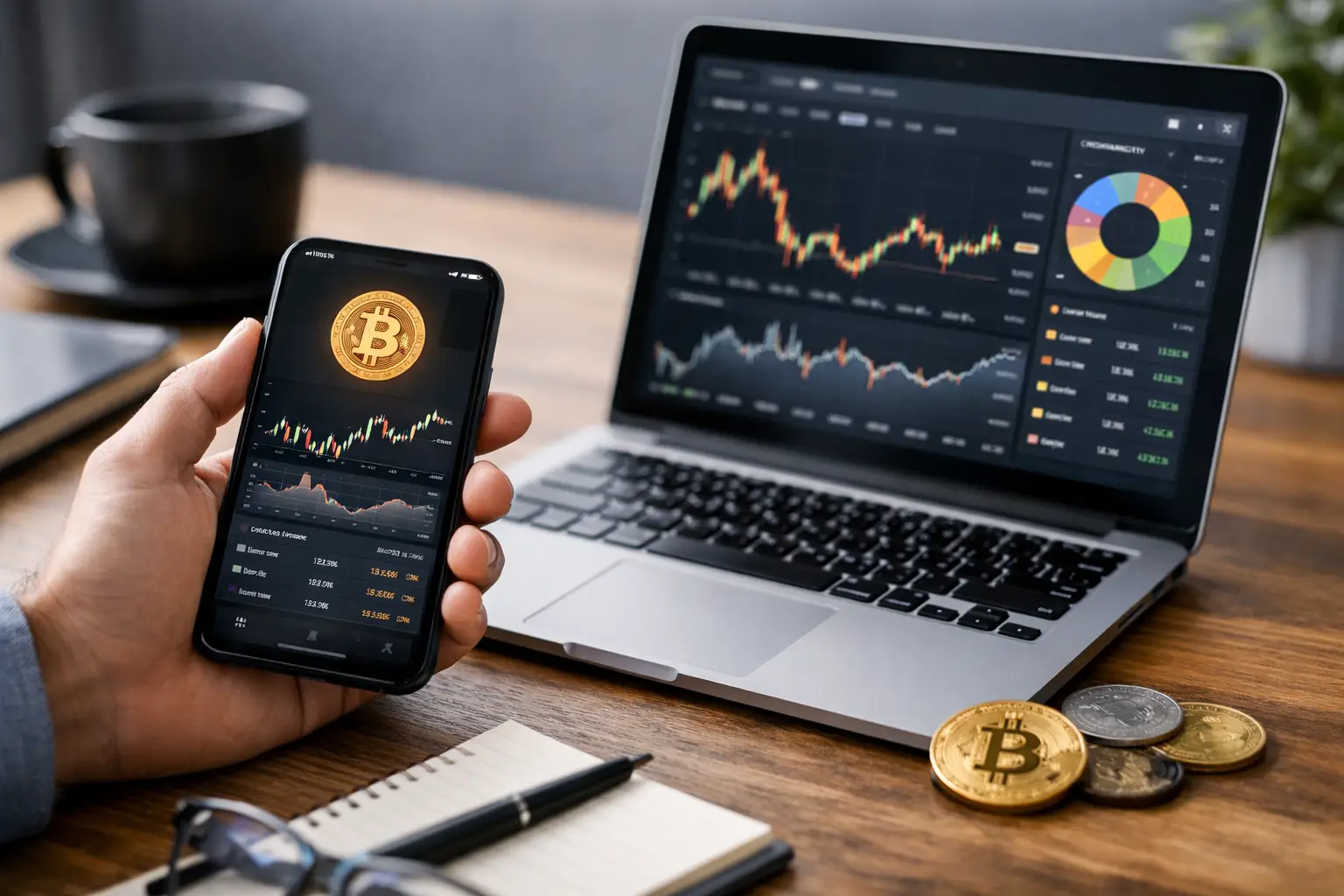
A Bitcoin portfolio doesn’t necessarily require hours of analysis. Yet, many investors open several apps, check the price multiple times a day, and end up with more questions than answers. If you’re looking for a bitcoin portfolio tracker app comparison, the best tool isn’t the one with the most charts. It’s the one that helps you stick to your strategy without turning your long-term investment into a full-time job.
For a Bitcoin holder, the need is simple: know where you stand, understand what’s really moving, and avoid decisions made under stress. Not all apps serve the same purpose. Some are for buying, others for monitoring a portfolio, and others for analyzing cycles. Comparing them using the same criteria helps you avoid picking an appealing but useless tool for daily use.
Bitcoin Portfolio Tracker App Comparison: Start with Your Real Need
Before comparing features, ask yourself a direct question: what do you expect from this app each week?
If you bought Bitcoin to hold for several years, you probably don’t need a screen full of trading signals, dozens of technical indicators, and alerts for every price movement. You need reliable tracking of your position, a reference point for the market context, and clear information.
On the other hand, if you hold Bitcoin on multiple platforms or wallets, your priority may be to centralize your holdings. The issue then isn’t market analysis, but having an overview. How much BTC do you really own? What is your total value? What is your average purchase price? Without these answers, it becomes difficult to follow a strategy calmly.
Finally, some investors mainly want to better read Bitcoin’s major cycles. They don’t want to trade every move, but to understand whether the market is in a tense phase, euphoria, or a pullback. A useful tracker app should translate this information into concrete benchmarks, without requiring you to master on-chain analysis or macroeconomics.
The 6 Criteria That Make the Difference
1. A Clear View of Your Portfolio
The first criterion seems obvious, but is often poorly addressed. A good app should let you quickly see the amount of Bitcoin you hold, its current value, your portfolio’s performance, and ideally, your overall performance.
This view should remain understandable even if your BTC is split between an exchange, a hardware wallet, and a personal storage solution. The goal isn’t to check your balance ten times a day. It’s to get a reliable overview in a few minutes, without having to piece together your information in a spreadsheet.
However, pay attention to the connection method. A serious tracking app doesn’t need your recovery phrases or private keys. To monitor a portfolio, a public address or read-only connection is usually enough. If a tool asks for sensitive information without a clear reason, move on.
2. Useful Data Instead of Noise
The Bitcoin price is available everywhere. What’s often missing is context. A 4% move may seem huge in a day, but almost insignificant over several years. An app designed for long-term investing should put the numbers in perspective.
Look for information that answers simple questions: is the underlying trend positive or fragile? Is the market particularly volatile? Is the current price far from recent levels? What macroeconomic factors could influence investor behavior?
The trap is to confuse the quantity of data with decision quality. A table full of charts can be impressive, but not help you act. For a HODLer, three clearly explained indicators are better than twenty incomprehensible metrics.
3. Accessible Cycle Reading
Bitcoin moves in phases. It goes through periods of accumulation, acceleration, excess, then correction. No one can predict the next move with certainty. However, understanding the current cycle helps avoid two common mistakes: buying out of fear of missing a rally and selling in panic during a drop.
The best apps don’t promise to predict the future. They show contextual signals and explain what they might mean. That’s a crucial difference. A promise of returns or an automatic buy signal should make you cautious. A tracker tool should support your judgment, not decide for you.
This is precisely the value of an AI-assisted approach: filtering scattered data, summarizing what matters, and highlighting changes that deserve your attention. Yapuka Holder follows this logic by helping investors read Bitcoin trends and market cycles in a more structured way, without having to analyze dozens of sources.
4. Alerts That Protect Your Attention
Alerts are useful when they save you from constant monitoring. They become counterproductive when they push you to check the market with every notification.
Favor tools that let you choose relevant alerts: crossing a level you set, unusual movement, significant indicator change, or context shift. You should be able to adjust their frequency and easily turn them off.
A good test is simple: after setting up the app, do you feel calmer or more dependent on your phone? In the first case, it saves you time. In the second, it probably adds to the noise you’re trying to reduce.
5. An Experience Suited for Non-Tech Users
You don’t need to be a quantitative analyst to seriously track a Bitcoin investment. An effective app uses simple words, explains key terms, and highlights priority information.
This is especially important if you’re already busy with your job. A plumber between jobs, a hairdresser at the end of the day, a mechanic, an electrician, a landscaper, or a renovation entrepreneur doesn’t need a second job as a market analyst. They need a clear status update, accessible from their phone or computer, that doesn’t require an hour of training.
Simplicity doesn’t mean the tool is superficial. It means complexity stays in the background. You see what’s useful for your decision, not all the technical steps needed to produce the information.
6. Logic That Matches Your Strategy
The best tool also depends on your method. If you invest a fixed amount each month, you’ll want to track your average price, the regularity of your purchases, and Bitcoin’s share in your assets. If you already have a large position, risk management and storage security become more central.
Some apps excel at performance tracking. Others focus more on news, charts, or taxes. They can be complementary, but avoid multiplying tools unnecessarily. Three poorly used apps don’t give you more control than one well-chosen solution used with a simple routine.
Which App to Choose Based on Your Profile?
The beginner gradually buying Bitcoin should prioritize clarity, security, and clear explanations. Their goal isn’t to react to every move, but to understand their portfolio and stay consistent with their investment horizon.
The intermediate investor, already exposed to Bitcoin and attentive to cycles, may look for an extra layer of analysis. They need market summaries, contextualized indicators, and selected alerts. The right tool helps reduce mental load, without giving the illusion that an algorithm eliminates risk.
The investor holding BTC on multiple platforms should pay special attention to data centralization and privacy. Ease of use should never come at the expense of security. Check what the app can access, what it stores, and the permissions it requests.
A Simple Routine Is Better Than Constant Monitoring
A tracker app only works if it fits into a realistic routine. For many long-term holders, a weekly check is enough: review your portfolio’s overall performance, read the market context, and make sure your strategy still fits your goals.
Once a month, you can supplement this by asking a broader question: does your Bitcoin exposure still match your risk tolerance and financial situation? Bitcoin remains a volatile asset. Smart tracking isn’t about denying this risk, but seeing it clearly without letting every fluctuation take over.
The right choice, in this bitcoin portfolio tracker app comparison, is the one that gives you reliable benchmarks, saves you time, and keeps you in control. If you understand your position better after five minutes than after an hour of charts, you’re on the right track.