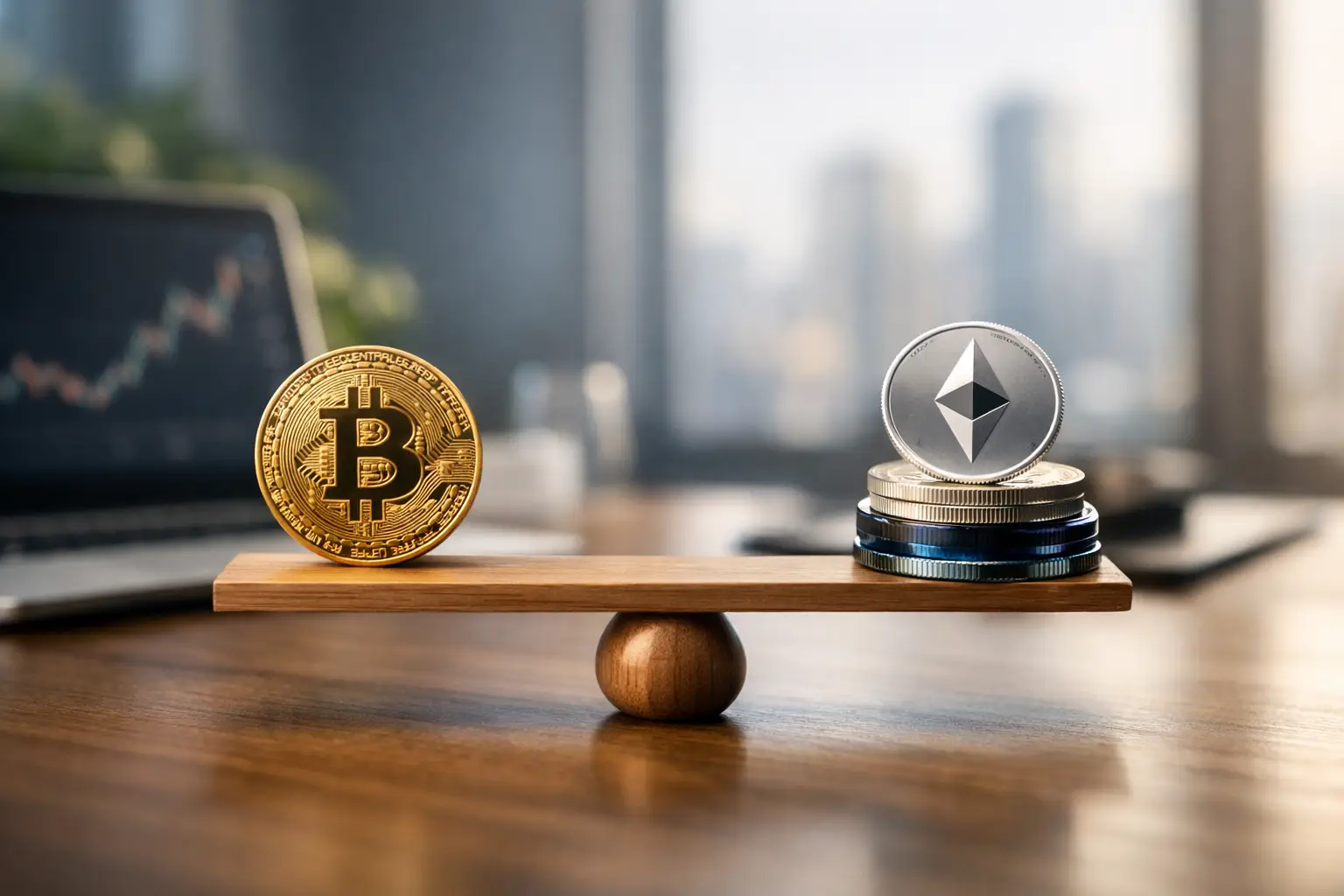
An investor who buys a cryptocurrency just because it has risen by 40% in a week is not truly choosing between altcoin or Bitcoin: they are simply following an existing trend. The real question is what level of risk, time horizon, and role you want cryptoassets to play in your portfolio. Bitcoin and altcoins serve different needs, even if they often move within the same market.
For beginners, this distinction is crucial. Bitcoin is generally seen as the benchmark asset in the sector. Altcoins include all other cryptocurrencies, from established projects like Ethereum to very recent tokens that are sometimes illiquid and hard to evaluate. This diversity creates opportunities, but also greatly increases the need for analysis.
Altcoin or Bitcoin: A Fundamental Difference
Bitcoin was designed as a decentralized monetary network. Its maximum supply is capped at 21 million units, it has the longest track record in the crypto market, and its liquidity is usually higher than that of other digital assets. It remains volatile, but its behavior is often considered more predictable than that of smaller projects.
An altcoin is a very broad category. It can be a blockchain for decentralized applications, a decentralized finance protocol, a privacy-focused network, a governance token, or an asset tied to a specific use case. Ethereum, for example, also serves as infrastructure for many applications. Conversely, some tokens have only limited utility, a fragile community, or a technical promise that does not translate into real adoption.
Saying that altcoins are “riskier” is accurate, but incomplete. The risk does not come solely from volatility. It can stem from token concentration in a few wallets, low liquidity, an unlock schedule that increases supply, a technical flaw, a regulatory change, or simply a team that fails to deliver on its promises.
Why Bitcoin Remains the Starting Point for Many Portfolios
Bitcoin accounts for a large share of the crypto market capitalization. It attracts retail investors, but also institutional players, companies, and regulated financial products in several jurisdictions. This market depth does not protect it from sharp declines, but it generally reduces the risk that a single large sale will wipe out liquidity.
Its investment thesis is relatively simple: a rare digital asset, globally accessible, with no central authority able to change its issuance. This simplicity is an advantage for beginners. You can track a few fundamental metrics—price, volume, liquidity, long-term holding, market cycles—without having to analyze the internal economics of dozens of protocols.
This does not mean that Bitcoin is a safe investment in the traditional sense. Its price can experience deep and prolonged corrections. Too much exposure can therefore unbalance a portfolio. Bitcoin is more suitable for someone who accepts this volatility, has precautionary savings, and thinks in terms of several years, rather than someone seeking quick results.
Altcoins Offer More Scenarios, Not Guaranteed Gains
Altcoins are attractive because a small project can experience much stronger growth than Bitcoin. This potential exists, especially when a technology addresses a clear use case and adoption grows. But the reverse is also true: an altcoin can lose 80%, 90%, or more, and never recover its previous high.
The most common trap is confusing a low unit price with a low valuation. A token at €0.10 can be much more expensive, in terms of market cap, than a token at €1,000. To compare two projects, look at the circulating market cap, then the fully diluted valuation. The latter takes into account tokens that may be released to the market later.
Before considering an altcoin, try to answer concrete questions. What problem does the network solve? Are users or developers actually using it? How does the project generate demand for its token? How much of the supply remains to be unlocked? Who holds the tokens? If the answers rely mainly on promises, a social media campaign, or recent price increases, the analysis is insufficient.
The market environment also matters. When Bitcoin rises sharply, some capital may then flow into major altcoins, and then into more speculative assets. This phenomenon, often called altcoin season, is neither automatic nor lasting. It can end quickly when liquidity contracts or risk aversion returns.
Comparing Risk with a Simple Method
The choice should not be about picking sides. It’s about building an exposure that fits your situation. A beginner investor may choose to stick to Bitcoin while learning about custody, cycles, and risk management. A more experienced investor may allocate a limited fraction of their crypto portfolio to a few altcoins they can actively monitor.
Start by defining the amount you could see drop significantly without jeopardizing your essential plans. Cryptoassets should not replace emergency savings or fund short-term expenses. Then set a time horizon: a few months and several years require different decisions and tolerance for fluctuations.
A gradual approach is often more rational than a one-off purchase driven by emotion. Investing a fixed amount at regular intervals can reduce the risk of buying just before a major drop, though it does not eliminate market risk. For altcoins, this discipline should be complemented by position sizing rules. The newer, less liquid, or more complex the project, the smaller its potential place in a portfolio should be.
Diversification also needs to be understood correctly. Holding ten altcoins does not guarantee real diversification if they all fall together during a market move. Many digital assets remain correlated to Bitcoin and global liquidity conditions. Diversifying means not making your outcome depend on a single hypothesis, not just multiplying positions without conviction.
Key Indicators to Monitor Before Deciding
Price alone says little. For Bitcoin, tracking its market dominance, trading volumes, volatility, and performance versus other asset classes can provide context. For altcoins, you need to add protocol-specific data: number of active users, total value locked when relevant, revenue or fees generated, development activity, holder distribution, and upcoming token unlocks.
Technical analysis can then help choose an entry point or avoid buying during excessive acceleration. It cannot predict the market with certainty. Likewise, fundamental analysis does not protect against a macroeconomic shock, regulatory decision, or crisis of confidence. Combining several signals is more useful than searching for the perfect indicator.
In France, also keep a precise record of your transactions. The taxation of digital assets depends in particular on the nature of the transaction and your situation. The rules may change. Anticipating the tracking of purchase prices, sales, and fees helps avoid discovering a reporting or tax obligation too late. If in doubt, a qualified professional remains the appropriate contact.
What Allocation for Your Profile?
There is no universal percentage. Someone new to cryptoassets may prefer to observe, take a small position in Bitcoin, and learn before considering altcoins. Someone with an established method, time to analyze projects, and a high tolerance for volatility may consider a share of altcoins, while explicitly accepting the risk of loss.
The decisive point is knowing why each asset is held. If you cannot explain in a few sentences the function of a token, its risks, and what would make you change your position, it is probably too early to buy it. Conviction does not replace method, and an active community does not replace verifiable data.
Using AI to Make Better Decisions Without Delegating Judgment
An AI or specialized agent can make this work easier by centralizing market data, comparing market cap, volumes, Bitcoin dominance, and protocol-specific metrics. It can also flag token unlocks, unusual volatility, or excessive concentration in your portfolio. Automated tools, like those offered by Yapuka Trader, can thus reduce mental load and save time on reading key signals. They do not replace your strategy or responsibility: AI helps structure a clearer decision, but never guarantees a profit.