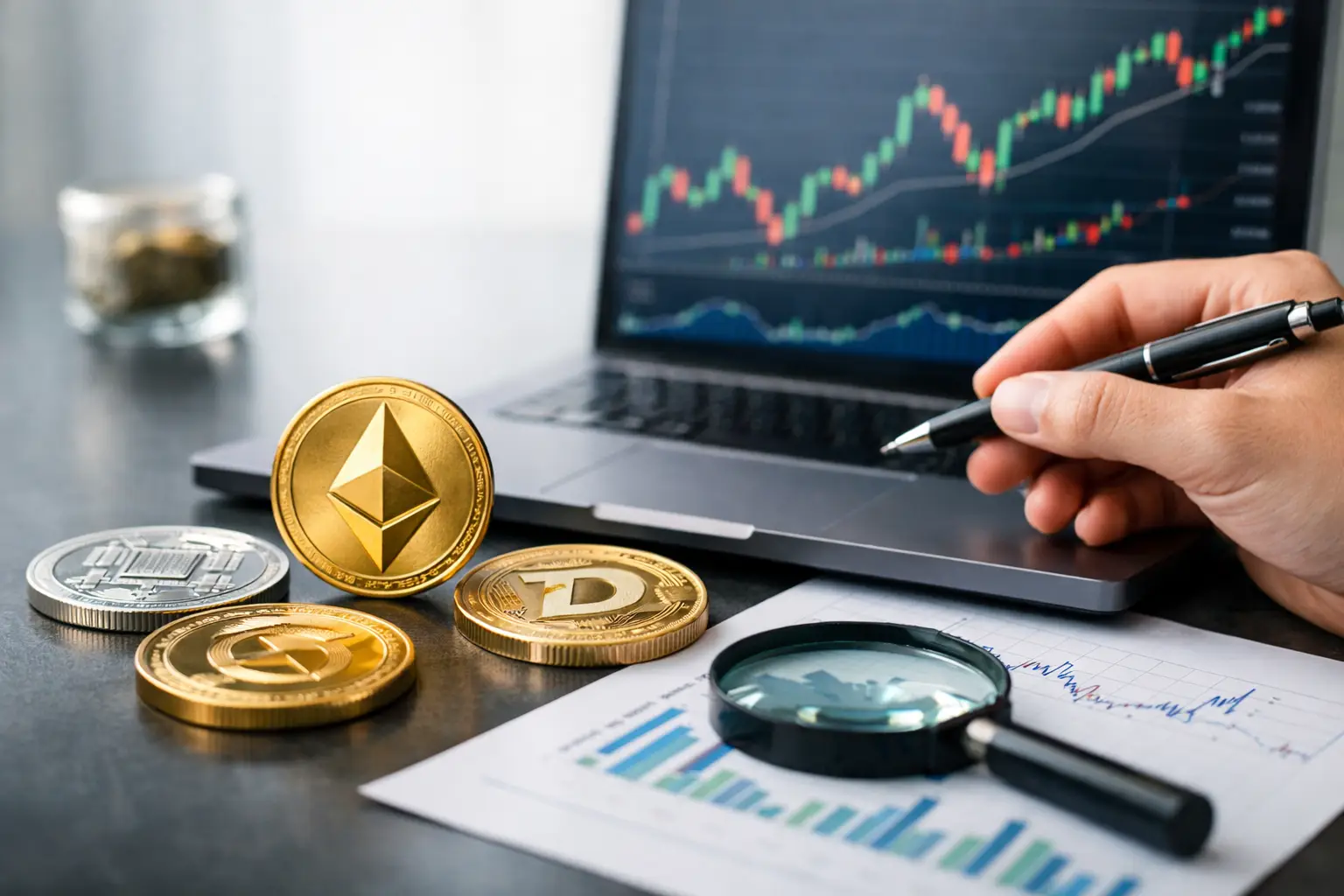
A token jumps +40% in a single day, its name is trending on social networks, and its price seems to be on a spectacular trajectory. Before asking whether to buy it, the better question is simpler: what is an altcoin, exactly? Understanding this term helps avoid lumping all cryptocurrencies into the same category and better assess what you are actually buying.
An altcoin can offer technical utility, access to a growing sector, or simply high volatility. These realities are not mutually exclusive. For a self-directed investor, the goal is not to chase the next skyrocketing asset, but to distinguish a comprehensible project from an asset driven solely by current hype.
What Is an Altcoin? A Simple Definition
The word altcoin is a contraction of alternative coin, meaning an alternative cryptocurrency. Historically, it refers to all cryptocurrencies other than Bitcoin. Since Bitcoin was the first decentralized digital asset and remains the most well-known, the thousands of projects that appeared after it have been grouped under this label.
In common usage, Ether, the native token of Ethereum, is therefore an altcoin. The same goes for Solana, Chainlink, Avalanche, or Uniswap. This definition is useful, but very broad: it brings together assets that do not have the same function, maturity, or risk profile.
Some players separate Ethereum from the rest of the market due to its size and central role. They then refer to Bitcoin, Ether, and altcoins. This shortcut can be useful for commenting on market movements, but it does not change the basic principle: an altcoin is a crypto asset distinct from Bitcoin.
An Altcoin Is Not Always a Currency
The word coin suggests it is necessarily a currency intended for payments. In practice, altcoins can serve several functions. Some are used to pay network fees or secure transactions. Others provide access to an application, enable voting in decentralized governance, or facilitate exchanges between digital assets.
It is also important to distinguish coins from tokens. A coin generally has its own blockchain, like Solana on its eponymous network. A token is created on an existing blockchain, such as Ethereum or Solana. This difference is technical, but it matters: a token partly depends on the security, fees, and availability of the network hosting it.
Stablecoins are also often classified as altcoins, even though their objective is different. They aim to maintain a value close to a currency, often the US dollar, rather than appreciate. They can be practical for transferring funds or temporarily reducing exposure to volatility, but their stability depends on the mechanism used and the quality of reserves, if any.
The Main Categories of Altcoins
Grouping altcoins by use helps analyze their economic logic. A layer 1 blockchain, for example, aims to provide a complete infrastructure for applications and transactions. Its token can be used to pay network fees and participate in its security.
Layer 2 solutions aim instead to improve speed or reduce transaction costs on an existing blockchain. Decentralized finance protocols, or DeFi, offer exchange, lending, or automated yield services. Infrastructure tokens can provide data, storage, computing power, or interoperability services between blockchains.
Finally, memecoins form a separate category. Their value often relies more on a community, cultural reference, and speculative momentum than on a clear technical utility. This does not mean they cannot surge, but their analysis is based on very different factors from those of an established technology network.
A common mistake is to compare all these assets using the same criteria. A governance token, a layer 1 blockchain, and a stablecoin do not meet the same needs. Their potential and risks must therefore be evaluated in context.
Why Are Altcoins More Volatile?
Most altcoins have lower capitalization and liquidity than Bitcoin. In practice, a smaller volume of buying or selling can be enough to move their price significantly. When a market is enthusiastic, this amplifies gains. When it turns, it also amplifies losses.
The market cycle also plays a major role. Bitcoin often attracts the first inflows during a bullish phase. Some investors then turn to Ether, then to smaller projects in hopes of higher returns. This rotation is sometimes called altcoin season. It is neither automatic nor lasting, and can end abruptly.
The token supply is another decisive factor. A project may show a seemingly high capitalization while still having many locked tokens that will be released later to the team, early investors, or the treasury. These unlocks can increase selling pressure if demand does not keep up. The current price never tells the whole story.
How to Analyze an Altcoin Before Investing
Analysis starts with a direct question: what problem is this project trying to solve, and why is its token necessary? If the answer remains vague after some research, caution is warranted. An interesting technology also does not guarantee that the token will capture value.
Next, examine real adoption. Does the network have active users, developers, used applications, or verifiable partners? Data such as trading volume, value locked in DeFi protocols, or number of transactions can provide clues. However, these must be interpreted carefully, as some indicators can be temporarily inflated by financial incentives.
The token’s economic structure deserves special attention. You need to understand the maximum supply, the amount already in circulation, the unlock schedule, and the distribution between the team, early investors, and the community. A strong concentration among a few wallets increases the risk that a sale decision will strongly affect the market.
At a minimum, check four elements before making any decision:
- the token’s concrete utility in its ecosystem;
- measurable network and user activity;
- supply distribution and future unlocks;
- available liquidity and protocol-specific risks.
The team, technical documentation, and security are just as important. A code audit does not eliminate hacking risk, but a total lack of information about security, the people in charge, or how the project works is a red flag. In crypto, transparency does not replace vigilance, but its absence should weigh in your decision.
Risks Not Shown by the Price
An altcoin can lose a large part of its value even if the overall market is rising. Technological competition evolves quickly, users can migrate to another protocol, and regulatory rules can affect certain projects or exchanges.
There are also operational risks: sending errors, loss of private keys, fake websites, malicious contracts, or wallet hacks. For beginners, holding assets on a platform or interacting with a decentralized application without understanding the steps can create more risk than the investment itself.
Diversification does not solve everything. Holding ten altcoins linked to the same theme, such as DeFi or artificial intelligence, does not necessarily constitute real diversification. In times of stress, their prices can fall together. A modest allocation suited to your time horizon, risk tolerance, and financial situation is often more rational than multiplying positions that are hard to track.
Investing or Trading an Altcoin: Two Different Approaches
Investing generally means believing in a thesis over several months or years: growing adoption, product improvement, increased protocol revenue, or ecosystem development. This approach requires regularly reassessing your thesis, especially during token unlocks, technical updates, and competitive changes.
Trading is a shorter-term logic. Price, volumes, technical levels, and market sentiment play a bigger role. This method requires a precise framework: position size, invalidation level, loss management, and discipline in the face of volatility. Without defined rules, the investor risks turning a speculative position into a forced investment after a drop.
In both cases, avoiding excessive leverage is a rule of caution. Altcoins can already experience significant daily swings without borrowing. Leverage mechanically increases possible losses and reduces the margin for error.
Using AI to Better Track Altcoins
Tracking several altcoins requires cross-referencing price, volume, supply, news, and on-chain activity data. An automated tool or AI agent can help centralize this information, detect unusual changes, flag token unlocks, or compare indicators across projects. It reduces mental load and saves time, especially when the market moves quickly.
Its role is not to predict gains or replace your judgment. The healthiest approach is to use AI to ask better questions, check a thesis, and spot signals that deserve human analysis. Clearer decisions come from a documented process, consistent risk management, and the ability to recognize what data cannot yet confirm.