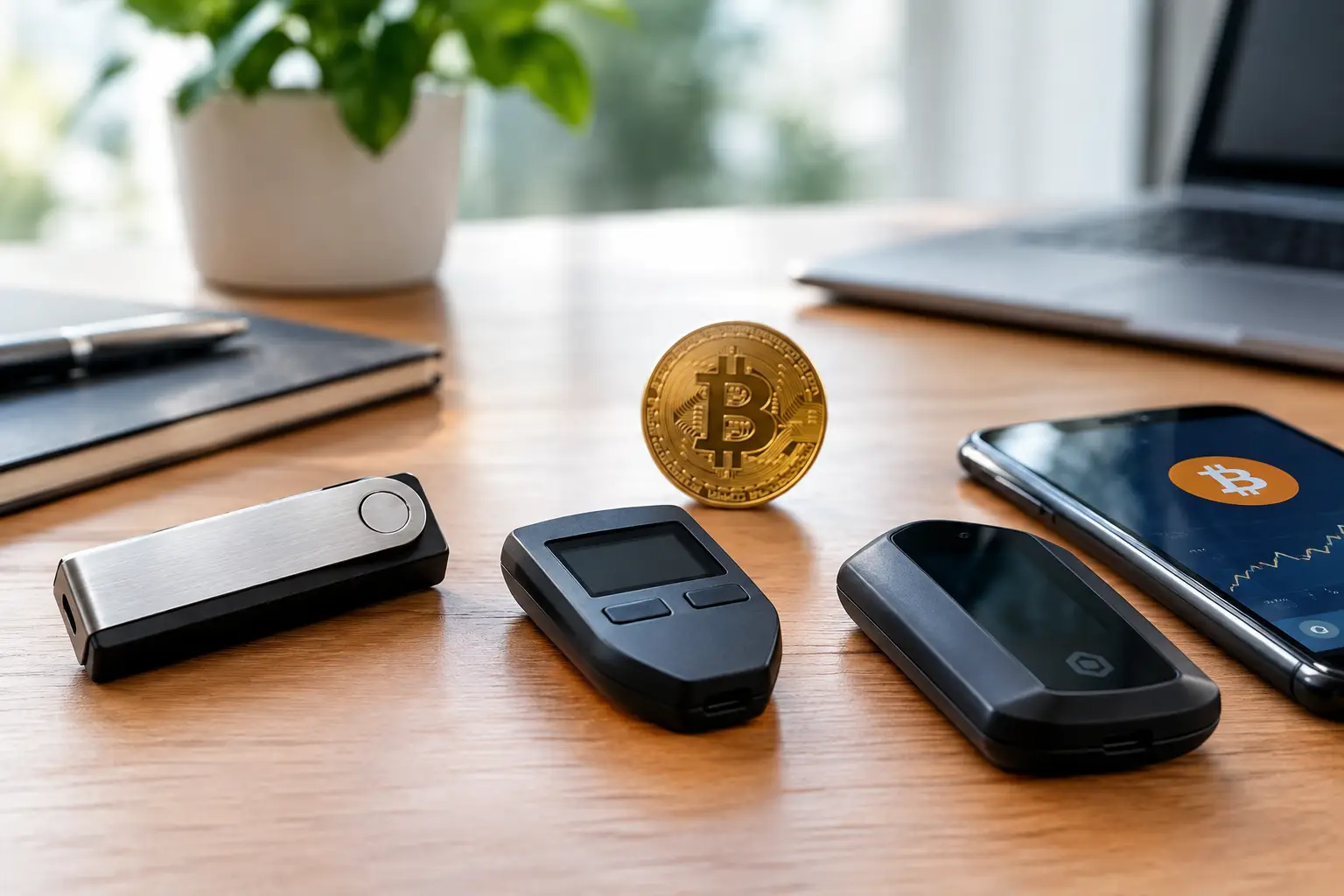
A Bitcoin wallet does not actually hold your bitcoins. It protects the keys that allow you to spend them. This difference sounds technical, but it changes everything in a secure bitcoin wallet comparison: the best choice is not necessarily the most expensive one, nor the one that promises the most features. It is the one you will know how to use properly, back up and keep for several years.
For a long-term investor, the point is not to check your balance ten times a day. It is to reduce avoidable risks: a platform being hacked, a recovery phrase stored badly, a lost phone or a mistake when sending funds. A simple, understood and well-organized solution is worth more than a very sophisticated setup abandoned after two weeks.
Secure bitcoin wallet comparison: the options
Bitcoin wallets can be grouped into four main families. They do not offer the same level of protection, nor the same everyday ease of use.
| Wallet type | Security against remote hacking | Simplicity | Most suitable use |
|---|---|---|---|
| Exchange platform | Low to medium | Very simple | One-off purchase, small temporary amount |
| Mobile wallet | Medium | Simple | Small spending and day-to-day tracking |
| Hardware wallet | High | Accessible after setup | Long-term storage |
| Multisignature | Very high | More demanding | Significant assets and rigorous organization |
Leaving your bitcoins on a platform: convenient, but incomplete
Buying Bitcoin on a platform is often the first step. It is quick, access is protected by a password and two-factor authentication, and the interface is familiar. The problem is simple: the private keys are not entirely under your control. You depend on the security, the rules and the availability of the company.
This solution may be fine for a few days, long enough to make a purchase or convert a small sum. For a HODL strategy, leaving a large part of your portfolio there amounts to delegating a risk you can limit. Enable at least app-based two-factor authentication, a unique password and login alerts. But do not confuse these protections with self-custody.
The mobile wallet: the right compromise for a small reserve
A Bitcoin app on a smartphone lets you hold your keys directly. It is better suited than a platform for a modest sum that you want to check or use easily. Its main advantage is speed. Its main drawback is that a connected phone remains exposed to theft, malware and handling errors.
The mobile wallet becomes relevant if you clearly separate your uses: a small sum available on your phone, and the bulk of your Bitcoin savings in a dedicated solution. Protect the app with a strong code, lock your phone and avoid installing unknown apps. Security depends as much on your habits as on the wallet chosen.
The hardware wallet: the logical choice for the long term
A hardware wallet is a dedicated device that keeps the private key away from your computer and your phone. When sending bitcoins, you check the address and the amount on the device’s screen, then physically confirm the transaction. Even if your computer is compromised, the attacker cannot freely sign in your place.
For most long-term holders, it is the best balance between security and simplicity. It requires a bit of rigor at the start: initializing the device yourself, writing down your recovery phrase offline and doing a first test with a small sum. Once this framework is set, use remains very accessible.
Always buy the device new, directly from the manufacturer or a recognized reseller. A second-hand or already configured product can hide an attempted fraud. At startup, refuse any recovery phrase that is already printed or supplied in the box. Your device must generate this phrase in front of you, without any third party knowing it.
Multisignature: very protective, not always necessary
Multisignature requires several validations to move bitcoins. For example, two signatures out of three keys may be needed. You can then spread the keys across separate places or with trusted people. A lost key does not necessarily block access to the funds, while a thief who recovers only one cannot spend anything.
This approach reduces the risk of a single point of failure. On the other hand, it adds complexity: you need to document the setup, prepare recovery and understand precisely who holds what. For a limited amount, it can create more stress than security. It becomes relevant when your wallet represents a significant part of your assets, or when you want to organize family or professional holding.
The criteria that really matter
Comparing models on price alone is a common mistake. A 60-euro wallet that is properly backed up will be safer than a high-end device whose recovery phrase is lying around in a phone note.
First check that you really control your recovery phrase, also called a seed phrase. This sequence of words lets you restore your wallet if the device is lost, broken or stolen. It is therefore more important than the device itself. Do not photograph it, never send it by email and do not type it into any website. Keep it on paper or, for greater protection against fire and moisture, on a suitable metal medium.
Then look at the device’s screen. A screen that clearly displays the receiving address, the amount and the fees makes checking easier at the critical moment. The interface must also be understandable to you. If you do not know how to confirm a transaction or restore a backup, you risk making a mistake under pressure.
Finally, take your environment into account. A person living alone will not organize their backup like a couple with children. An investor who travels often will not have the same constraints as someone who keeps their documents at home. Good security is the kind that withstands your real daily life.
A simple method to choose without complicating your life
Start by defining the amount you are ready to expose to a mistake. For a small sum meant for learning, a mobile wallet may be enough. As soon as the loss would be hard to accept, a hardware wallet generally becomes more coherent. For a substantial portfolio, take the time to study multisignature or to separate backups with a documented method.
Then do a complete test before transferring the bulk. Send a small sum to your new wallet. Check the address on the screen, wait for it to arrive, then test a small outgoing transfer. This path removes a lot of anxiety: you know you master the steps before a significant amount is at stake.
Also prepare a recovery plan. If your phone disappears tomorrow, do you know where your backup is? If your hardware wallet no longer turns on, do you know how to restore your bitcoins with the recovery phrase? If the answer is no, your priority is not to buy another product. It is to get your organization straight.
The mistakes that cost the most
The first mistake is sharing your recovery phrase. No serious customer service, no technical support and no person claiming to help you needs it. A request for a seed phrase is an immediate warning sign.
The second is confusing backup with secrecy. Writing the words on a randomly hidden piece of paper may seem prudent, but your loved ones must be able to find the procedure in case of an accident, without the information being exposed to just anyone. The right level of detail depends on your family and financial situation.
The third is acting in a rush. Fraudsters play on urgency: account blocked, mandatory update, funds in danger. Take a few minutes, re-read the address shown on the device and verify the information through an official channel. Bitcoin does not allow you to cancel a transaction sent to the wrong address.
Wallet security and investor discipline
A secure wallet protects holding. It does not decide when to buy, add or wait. These two topics must remain separate. Your storage must be stable and rarely used; your investment strategy must rely on clear monitoring of your horizon, of your exposure and of market cycles.
That is precisely the point of a tool like Ya.puka Holder: filtering out market noise to better follow a long-term strategy, without turning the management of your Bitcoin into a full-time job. A better reading of the market does not replace your operational security, but it prevents emotion from pushing you to move or sell your funds without a plan.
Choose a wallet you understand, test it calmly and document your backup. Bitcoin security is not a race to the most technical solution: it is a series of simple decisions, made once, that then leave your mind free to stick to your strategy.