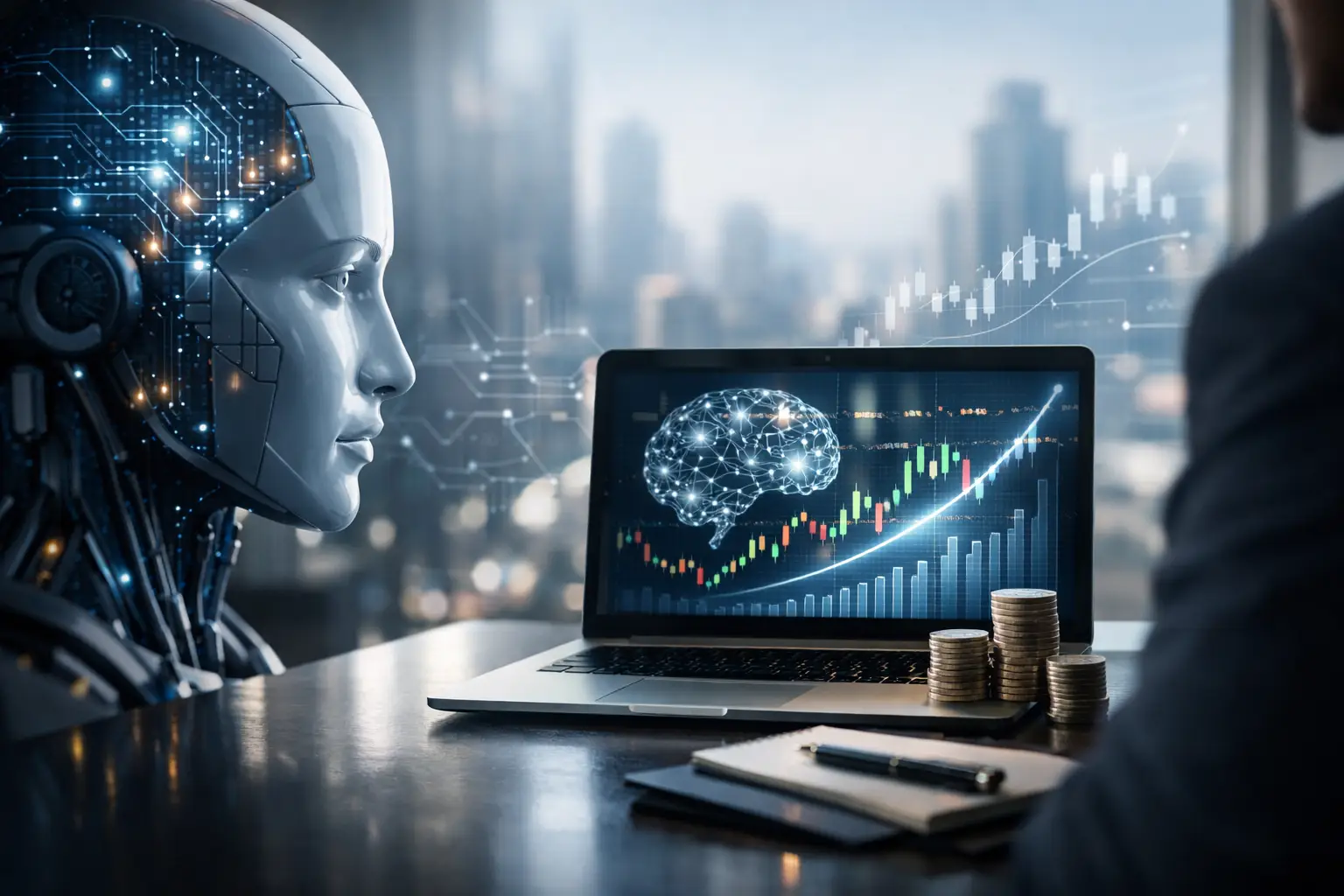
Today, a retail trader can consult thousands of data points in just a few minutes, without necessarily knowing which ones deserve their attention. This is where artificial intelligence trends in finance become meaningful: they are not just about automating faster, but about better prioritizing information to make less impulsive decisions.
For an independent investor, the goal is not to entrust their capital to a machine supposedly able to predict the future. It is to have tools capable of reading complex data, detecting regime changes, and presenting understandable analysis. AI is already changing financial research, risk management, and portfolio monitoring. But its usefulness still depends on data quality, the method used, and human judgment.
Artificial intelligence trends in finance: what is really changing
The first evolution concerns the shift from isolated tools to assistants capable of cross-referencing multiple sources. For a long time, an investor would use a chart for price, a news site for context, and a spreadsheet to track positions. AI systems can now bring these elements together: price movements, volumes, macroeconomic data, company results, news, and technical signals.
This centralization does not automatically make analysis correct. However, it does reduce the time spent collecting, cleaning, and comparing scattered information. For individuals, this time saving can be valuable, provided they keep a clear question in mind. For example: “Why is this asset’s volatility increasing?” or “What events explain this market move?” A good AI helps explore these questions. It should not replace them with an opaque recommendation.
Another major change: analysis is becoming more contextual. A technical indicator does not have the same meaning in a strong bull market, during a period of stress, or when a central bank decision is announced. Modern models seek to identify the market context before interpreting a signal. This approach is especially useful in crypto, where price movements can be swift and influenced by liquidity, sentiment, or regulatory announcements.
AI agents to organize analytical work
One of the most visible trends is the rise of specialized AI agents. Rather than relying on a single generalist tool, an investor can use several agents with distinct roles: one monitors news, another synthesizes technical data, a third compares the portfolio’s risk level with predefined rules.
This organization is interesting because it replicates a discipline often hard to maintain alone. An investor can set a routine: check important announcements, observe key price zones, measure sector exposure, and note the reasons for a decision. The agent does not necessarily act in their place. It prepares information and flags discrepancies that deserve a review.
Financial research becomes conversational
Conversational interfaces also make it easier to access topics once reserved for highly technical users. It is now possible to ask for a simple explanation of a financial ratio, to summarize a company’s quarterly results, or to compare the factors influencing two assets.
This simplicity has a limit: a well-formulated answer is not necessarily accurate, complete, or up-to-date. The investor must learn to verify key figures, the relevant period, and the data source. An AI can confuse a hypothesis with a fact, or present outdated information in a new context. The more significant the decision, the more rigorous human validation must be.
Automation is about rules, not blind control
Automated tools can monitor a price threshold, a volume spike, an unusual volatility change, or excessive concentration in an asset. They are often more useful in this monitoring role than as an autopilot.
Automating an alert is different from automating a buy or sell order. In the first case, the investor retains time to examine the signal. In the second, they expose their capital to configuration errors, faulty data, and sudden moves. Automated execution may suit some highly controlled strategies, but it requires testing, loss limits, and regular monitoring.
AI improves risk management, but does not eliminate it
The most credible promise of artificial intelligence is not perfect price prediction. It is more about managing attention and risk. A system can quickly calculate exposure to an asset, spot increasing correlation between positions, or highlight that a portfolio relies too much on a single economic scenario.
Take a portfolio made up of Bitcoin, tech stocks, and several altcoins. At first glance, the holdings seem different. In times of risk aversion, however, they may move in the same direction. AI-assisted analysis can highlight this dependence and remind that diversification is not measured by the number of holdings.
AI can also help detect anomalies. A volume spike, an unusual rise in social media mentions, or unexpected volatility does not say whether to buy or sell. They indicate that an event deserves closer analysis. This nuance is essential: a signal is an invitation to investigate, not a market certainty.
Data remains the weak point of many tools
A high-performing model on incomplete or biased data will produce fragile conclusions. In finance, the issues are numerous: limited historical data, differences between platforms, artificial volumes on some crypto markets, misinterpreted announcements, or rare events that cannot be properly learned.
Past performance also poses a classic trap. A model trained on a period of low rates and high liquidity may react poorly to an inflationary environment or a crisis of confidence. Markets change regimes. A strategy that seemed stable can lose relevance as economic, regulatory, or geopolitical conditions evolve.
For this reason, investors should favor transparent tools. A good tool indicates what it analyzes, how often data is updated, the model’s limits, and the level of uncertainty associated with its results. It does not turn a probability into a promise.
How to adopt these tools methodically
Starting with a concrete task is generally more effective than looking for an AI that can do everything. A beginner investor can use AI to understand an asset, summarize a report, or build a checklist before making a decision. A more experienced trader can use it to monitor several markets and spot deviations from their plan.
Method matters more than tool sophistication. Before using automated analysis, it is useful to define your investment horizon, maximum acceptable risk, and the criteria that would justify an entry or exit. Without this framework, AI may simply accelerate the search for confirmation of an existing intuition.
It is also relevant to keep a decision journal. Note the observed signal, the response, the context, and the outcome. Over time, this tracking helps distinguish truly useful alerts from those that create noise. It is a simple way to evaluate a tool based on your own process, rather than on an impressive demo.
A decision aid, not a substitute for judgment
Artificial intelligence trends in finance will continue to make analysis more accessible, faster, and more personalized. They can also reinforce certain biases if the user accepts analyses they do not understand without critical thinking. The best use of AI is therefore the one that increases clarity, not the one that maintains the illusion of total control.
An AI agent or automated tool like Yapuka Trader can help analyze large amounts of data, spot signals that deserve your attention, save time, and reduce the mental load of market monitoring. It becomes truly useful when it fits into a clear method, with risk rules and human verification. AI helps make decisions more calmly, but it never guarantees a profit or eliminates the risk of loss.