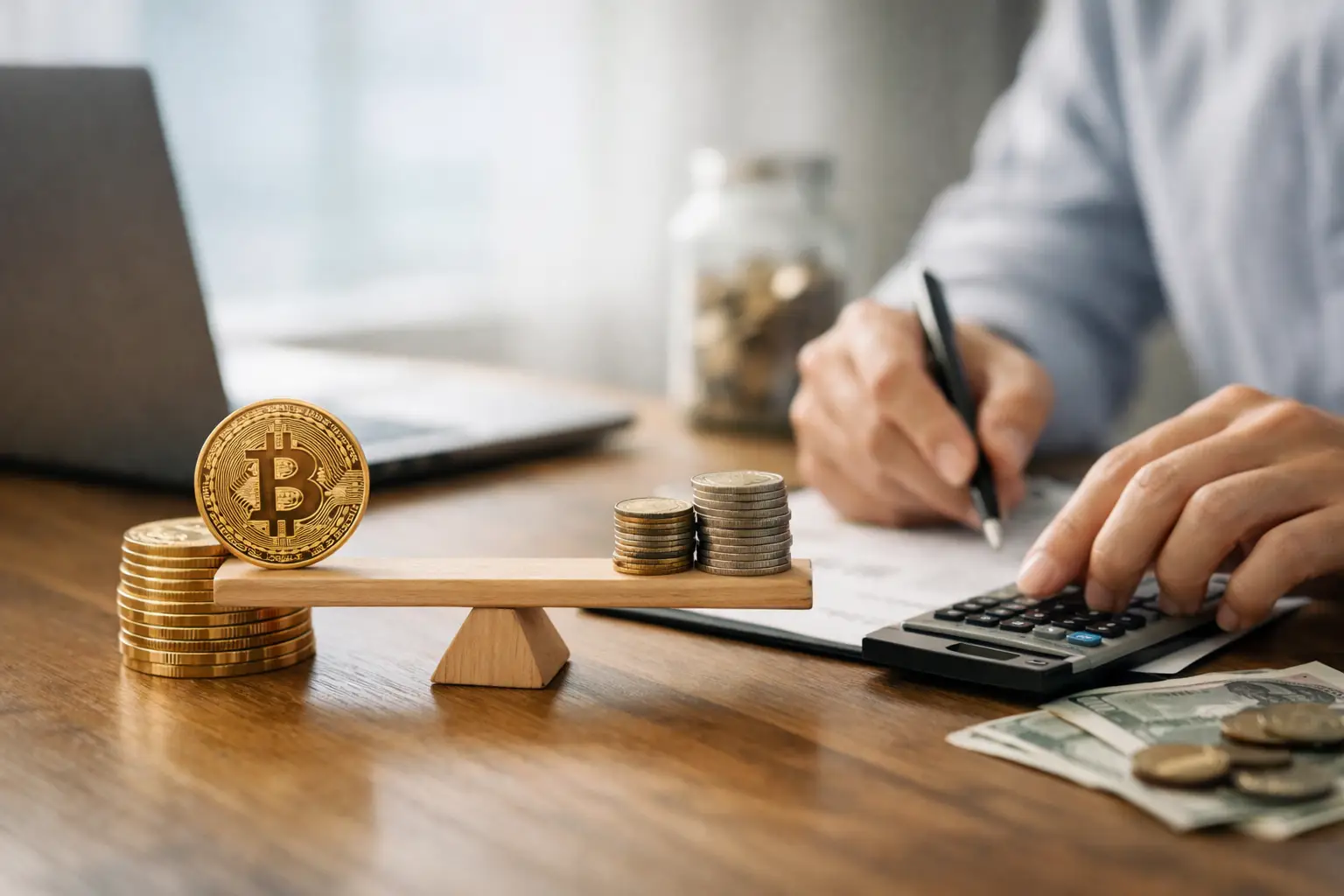
The question of “how much to invest in Bitcoin” can’t be answered with a magic percentage found on social media. The right amount is the one you can hold onto when the price drops sharply, without having to sell in a rush or sacrifice your projects. For long-term investing, the priority isn’t finding the perfect entry point. It’s about building a position you can truly keep.
A plumber starting a business, a beautician with regular income, a mechanic planning to upgrade equipment, or a renovation entrepreneur with variable cash flow will not have the same flexibility. The amount invested should be based on your real situation, not on a promise of returns.
How much to invest in Bitcoin based on your situation?
Before choosing a number, separate your money into three simple zones: daily expenses, emergency savings, and investments. Bitcoin belongs in the third zone. It should never take the place of rent, bills, upcoming taxes, or a fund set aside for major repairs.
Start by making sure you have an emergency fund. Its size depends on your job stability. An employee can aim for several months of living expenses. An independent electrician, a landscaper affected by the seasons, or a self-employed hairdresser will often need a larger buffer, as their income and expenses can vary more.
Next, look at what’s left each month after your bills, emergency savings, and short-term goals. If you have 300 euros left, investing all 300 euros in Bitcoin may not be wise. You’d have no margin for unexpected events. However, an amount like 30, 50, or 100 euros could make sense if it keeps you comfortable.
The right starting point is often more modest than you might think. This doesn’t mean lacking ambition. It lets you test your real tolerance for market swings before increasing your exposure.
The most useful test: can you handle a drop?
Bitcoin can rise quickly, but it can also fall sharply in a few days or over several months. So the question isn’t just: “how much can I invest?” Also ask yourself: “what would I do if this amount temporarily lost 30%, 50%, or more of its value?”
If your answer is that you’d check your phone all day, sleep poorly, or sell at the first sign of panic, your amount is probably too high. A suitable portfolio doesn’t remove emotion, but it makes it manageable.
Let’s take a simple example. You consider investing 5,000 euros. Imagine that after a few weeks, your position is only worth 3,000 euros. If this situation forces you to cancel a project, dip into your emergency fund, or sell in a hurry, the starting amount was too high. It’s better to start with 1,000 euros, or spread the amount over time.
This caution is especially useful for beginners. It prevents turning a long-term investment into an impulsive decision. Bitcoin remains a volatile asset. It can have a place in a portfolio, but it shouldn’t become a constant source of stress.
A simple method to define your amount
There is no universal rule, but a four-step method helps you decide without getting lost in calculations.
First, set aside your emergency fund before any investment. Next, identify the monthly amount you can save without reducing your quality of life. Then, choose a cautious portion of that amount for Bitcoin. Finally, decide in advance under what conditions you will increase, reduce, or maintain your purchases.
For someone starting out, allocating a small fraction of your financial assets to Bitcoin can be a reasonable approach. Some people prefer to start around 1 to 5%, then adjust after a few months. Others, already convinced of the asset’s long-term potential and with a strong financial situation, choose a higher share. However, this choice means higher volatility for your overall portfolio.
The percentage matters less than your ability to stick to the plan. An investor with 3% in Bitcoin held for several years is often better off than someone with 25% who sells after a drop. Consistency often beats overconfidence.
Invest all at once or gradually?
Investing a large sum at once can make sense if you’ve already set your allocation and accepted the risk. You’re immediately exposed to the market, which can be good if the price rises. But it can also be tough if a drop happens right after your purchase.
Gradual investing, often called DCA, means buying the same amount at a fixed frequency, for example every week or month. This approach doesn’t guarantee better returns. However, it simplifies the decision and limits the emotional risk of picking a single entry point.
For many long-term investors, this is the easiest solution to follow. An automatic amount of 50 euros per month is less impressive than a one-off purchase of 2,000 euros, but it may be more realistic. It saves you from waiting forever for “the right moment” and reduces mental load.
The method can also be mixed: a reasonable initial sum to start, then regular purchases. The most useful thing is to choose a pace that fits your budget. If your activity is seasonal, adapt it. A landscaper can invest more during the best months and reduce temporarily in winter. A restaurateur, craftsman, or freelancer can do the same according to their income.
Don’t confuse conviction with concentration
Believing in Bitcoin for the long term doesn’t mean putting all your savings into it. An overly concentrated portfolio makes you dependent on a single scenario. No one knows in advance the exact timing of cycles, regulatory decisions, or the macroeconomic context that will influence the market.
Keep your other priorities visible: paying off expensive debts, accessible savings, insurance, family projects, retirement, and growing your business. For an entrepreneur, the best use of some capital may sometimes be a work tool, training, or a cash reserve. Bitcoin doesn’t need to compete with these needs. It should find its place after them.
Rebalancing your portfolio can also help. If Bitcoin rises sharply and suddenly represents a much larger share than planned, you can decide to stop buying for a while, or gradually bring your allocation back to your target. Conversely, a drop doesn’t force you to buy more. Your plan should be guided by your budget, not by excitement or fear.
Follow the data without spending your life watching charts
A simple plan requires few decisions, but it deserves regular monitoring. Check your allocation, the actual amount invested, your time horizon, and your comfort level. A monthly or quarterly review is often enough for an investor who isn’t actively trading.
The problem is that the market constantly produces opinions, charts, and conflicting alerts. This abundance can push you to act too often. A platform like Yapuka Holder can help filter out this noise by presenting long-term trends, cycles, and useful indicators in a clearer format. The goal isn’t to tell you what to buy at every moment, but to help you keep a calm and structured view of your position.
Your rule can fit in a few lines: I keep an emergency fund, I invest a fixed amount compatible with my budget, I check my allocation at a set date, and I don’t act based on daily fluctuations. This simplicity is an advantage, not a limitation.
The best amount to invest in Bitcoin is the one that lets you stay calm when the market gets volatile. Start with a manageable sum, make your strategy regular, then let time do the work that impulsive decisions often prevent.