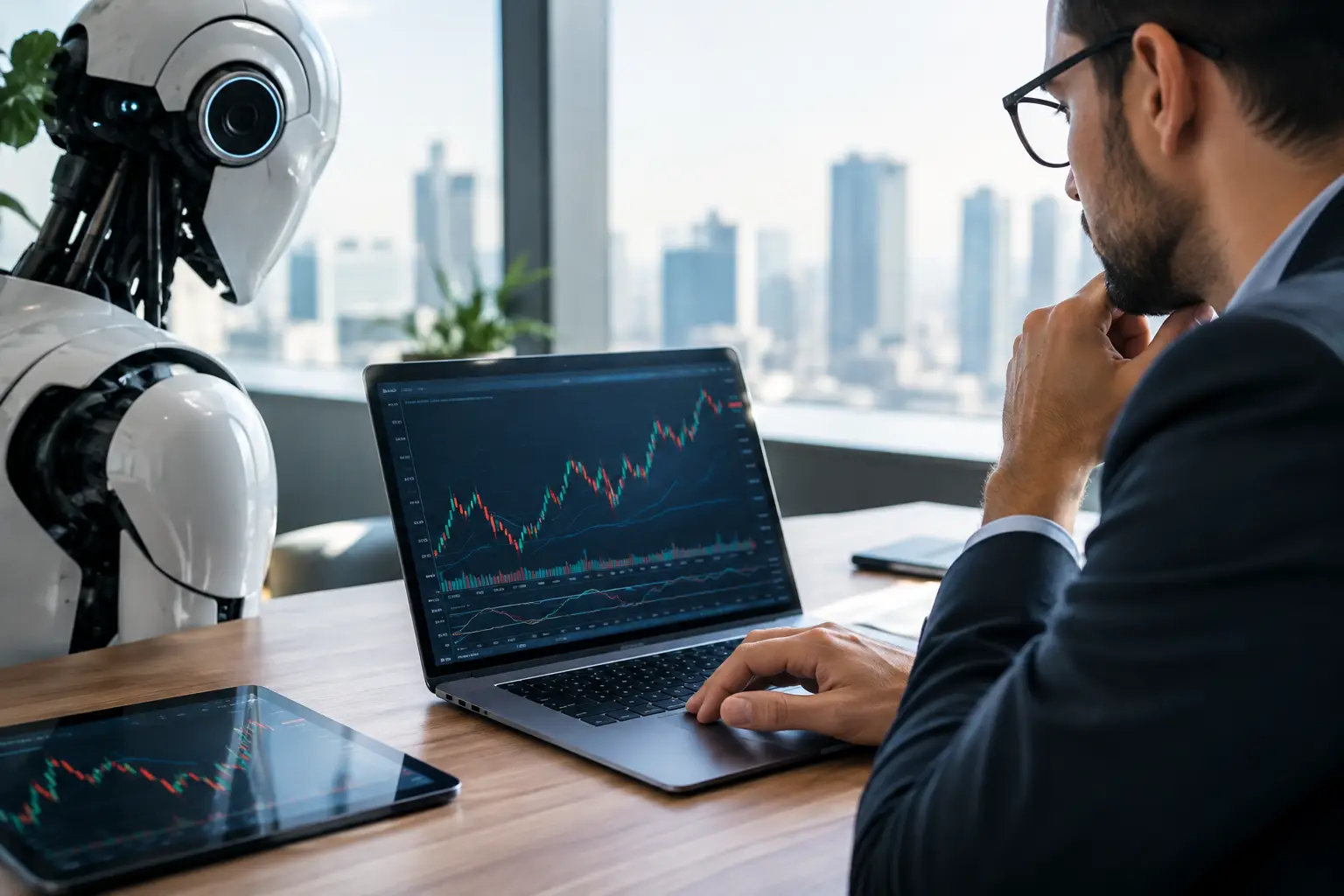
Algorithmic trading is no longer reserved for trading floors equipped with ultra-fast servers. Its evolution has made tools accessible to individuals that can filter thousands of data points, apply a method tirelessly, and monitor a market continuously. This democratization does not turn an algorithm into a profit machine. Rather, it changes the way traders prepare, test, and execute trading decisions.
For independent investors, the topic deserves more than promises of robots that would win on their behalf. Understanding the different stages of this evolution helps distinguish a useful tool from an opaque system, and reasonable automation from misunderstood risk-taking.
The evolution of algorithmic trading, from rules to adaptive models
Originally, a trading algorithm is a sequence of precise instructions. For example: buy an asset when its 20-period moving average exceeds the 50-period moving average, then sell if the trend reverses. The strength of this approach is its discipline. The algorithm does not doubt, does not panic after a drop, and does not increase a position to recover after a loss.
The first large-scale uses appeared in financial institutions. They often addressed operational needs: splitting a large order to limit its price impact, arbitraging differences between markets, or providing liquidity. High-frequency trading, often covered by the media, belongs to this universe. It relies on execution speed and infrastructure that remain largely out of reach for individuals.
However, it would be a mistake to reduce algorithmic trading to speed. For individual traders, its value lies more in the quality of the process: turning an idea into verifiable rules, observing its behavior on historical data, and following its execution consistently.
With increased computing power and access to market data, strategies have diversified. Some seek trends, others exploit mean reversion, volume, volatility, or behavioral differences between assets. In crypto, a system can also monitor liquidity, spreads between platforms, volatility changes, or activity in a market available 24/7.
From technical signals to machine learning
Machine learning has brought a new stage to the evolution of algorithmic trading. Instead of only setting conditions in advance, a model is trained to spot relationships in a dataset: prices, volumes, volatility, technical indicators, macroeconomic data, or variables specific to digital assets.
This approach can be relevant when interactions between variables become too numerous to analyze manually. But it introduces a major risk: overfitting. A model can produce impressive results on past data simply because it memorized its peculiarities, without identifying a lasting relationship. As soon as market conditions change, its performance can quickly deteriorate.
A good system is therefore not judged solely on its displayed success rate. One must examine the tested period, included fees, maximum drawdown, number of trades, covered market conditions, and out-of-sample results. A short history, built during a strong market rally, does not prove that a strategy will withstand a bear phase or extreme volatility.
What has become accessible to retail traders
Individuals can now use charting platforms, programming interfaces, conditional alerts, and backtesting tools without building institutional infrastructure. Automation can occur at several levels, each with very different risks.
The simplest level is automating observation. An alert can signal a threshold crossing, an unusual volume spike, or a rapid change in volatility. The trader then retains the final decision. This is often a relevant first step, as it reduces the need for constant monitoring without fully delegating judgment.
The next level automates the execution of a defined rule: an entry, an exit, a position size, and possibly a stop-loss. This method can limit hesitation but requires precise preparation. A poorly configured automatic order remains a poorly configured order, executed efficiently.
Finally, some systems combine analysis, scenario selection, and parameter adjustment. AI agents fall into this category when they can synthesize information, flag inconsistencies, or follow a risk checklist. Their usefulness depends not only on their sophistication but also on the clarity of their mission, the quality of the data used, and the control exercised by the user.
The limits that automation does not solve
An algorithm applies rules. It does not automatically understand the economic, political, or regulatory context that can render these rules unsuitable. A central bank announcement, a security incident on a crypto platform, or a macroeconomic release can abruptly change market behavior.
Costs are also frequently underestimated. A strategy that looks profitable on a chart can lose all appeal once fees, spreads, slippage, and actual available liquidity are factored in. Slippage refers to the difference between the expected price and the actual price obtained. It becomes particularly significant when the market moves quickly or the asset is illiquid.
Technical availability is another limitation. A dropped connection, API error, changed parameter, or incorrect data can be enough to distort a system’s behavior. Automation therefore requires controls: loss limits, position size caps, alerts, operation logs, and the ability to quickly stop the strategy.
There is also a paradoxical psychological risk. Some investors place too much trust in the system because it appears objective. Yet, an algorithm reflects the assumptions of its creator. If it is based on a poor market reading or insufficient data, it automates that error instead of correcting it.
Building a useful approach without seeking the perfect robot
For beginners, it is better to automate a simple method than to seek a complex model. A strategy should clearly answer a few questions: which market is involved, what is the trading frequency, what signal triggers an action, what risk is accepted per position, and under what conditions should the strategy be suspended?
Historical testing is a necessary but not sufficient step. It serves to check if an idea is consistent across several market periods. It should include realistic fee assumptions and avoid constantly tweaking parameters just to achieve an attractive result. The more settings a strategy has, the more likely it is optimized for the past rather than prepared for the future.
After backtesting, a phase of observation in simulation or with limited exposure allows the strategy to be confronted with real conditions. The goal is not to validate a promise of returns, but to check that execution, data, and risk management work as intended. Keeping a journal remains useful: it reveals whether results come from a favorable context, an error, or a reproducible logic.
A sound approach also involves separating analysis from execution. Even when a system places orders automatically, the trader should maintain an overview of their exposure. Several different algorithms can, in reality, take the same risk if all are exposed to the same asset, trend, or volatility spike.
Using AI to decide with more method
AI can help apply these principles without replacing the investor’s responsibility. An AI agent or automated tool can analyze large volumes of data, detect unusual signals, compare an asset to its historical behavior, summarize the market context, and check that a strategy follows its risk rules. It can also save time and reduce the mental load of continuous monitoring.
The goal is not to let a machine predict the future. It is to have better-structured information to ask better questions before acting. Used with clear limits, AI tools such as those offered by Yapuka Trader can support more transparent and disciplined decisions. They help analyze and prioritize, but never guarantee a profit and do not replace risk management or investor judgment.