
Why structure is the foundation
Before talking about indicators, support, FVG or Fibonacci, you need to understand market structure. Structure answers a simple question: is the market moving up, moving down or moving sideways?
If you cannot answer that question, you may interpret every movement as a signal when it is sometimes only noise. To identify a trend, we use Dow Theory, developed by Charles Dow.
Uptrend
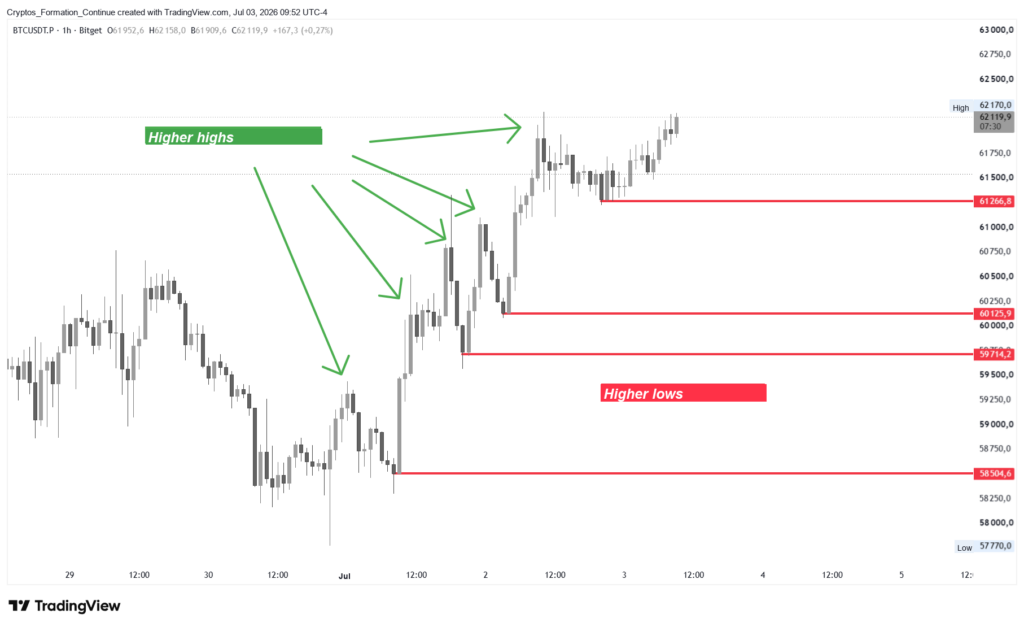
An uptrend is generally built with higher highs and higher lows. This means buyers are able to push the price higher after each correction.
In this context, we often look for areas where the price could pull back before moving higher again. In simple terms, we wait for a retracement, a small correction, before positioning ourselves.
Downtrend
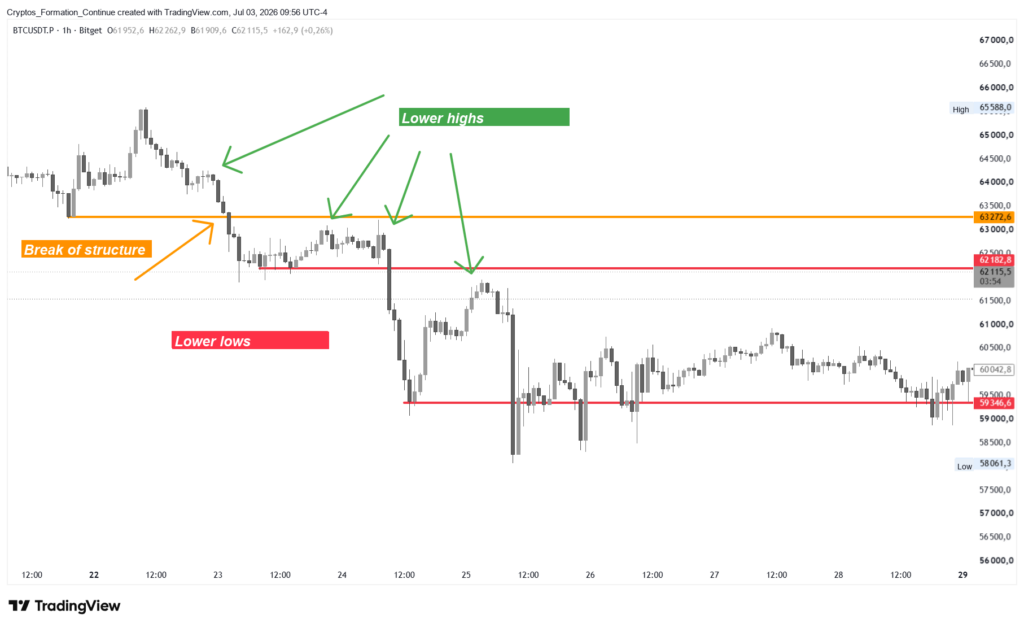
A downtrend is built with lower highs and lower lows. Sellers have more control over the market and rebounds can be rejected.
In this context, buying simply because the price has dropped a lot can be dangerous. You need to wait for signs of change. In simple terms, we wait for the market to start making higher highs and higher lows again.
Range
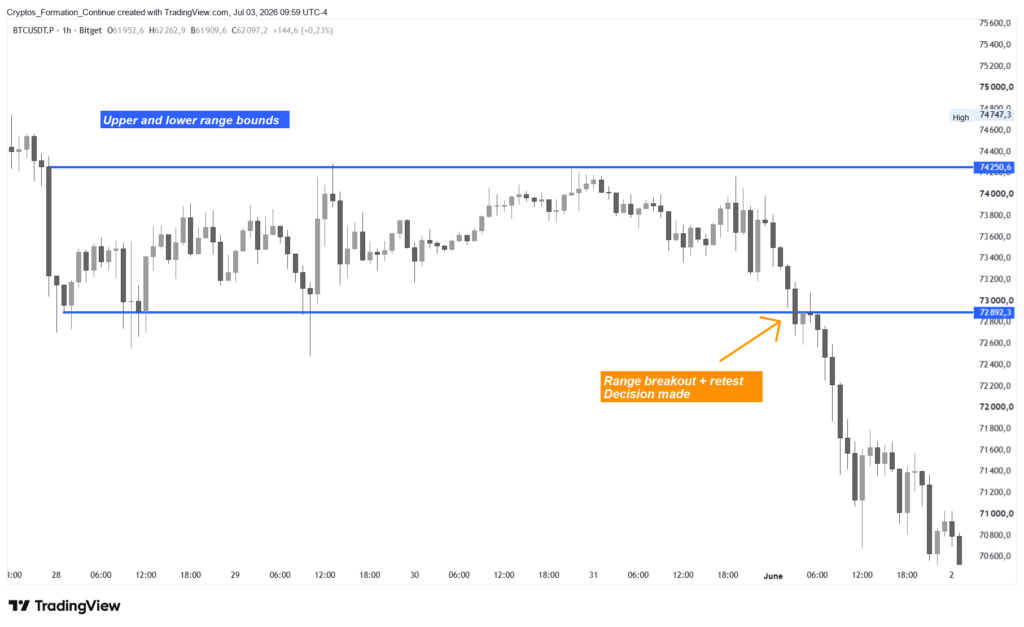
A range appears when the price is stuck between an upper zone and a lower zone. The market does not really choose a direction. It rises, falls, rises again, then repeats, inside a very limited amplitude. We say it is moving sideways. Unless you are a professional trader, it is better to avoid taking positions in this type of market and wait for a decision to be made, meaning a breakout from the range.
Change of structure
A change of structure happens when the market breaks its previous logic. For example, in an uptrend, if the price breaks an important low, the dynamic can change.
It is not an automatic signal, but it is a warning: the market is no longer behaving the way it did before.