Options: a complicated world, made simple by Ya.puka
Options are one of the most complicated subjects in finance. Strike, expiry, delta, gamma, market makers, hedges… even professionals sometimes get lost. Yet they can influence the price of Bitcoin. At Ya.puka, we wanted to make them readable for everyone: a summary in five markers, and cards that explain every figure.
*The indicator is available in your language, like all Ya.puka indicators.
Why options can influence the price
An option is a contract that gives the right to buy (a call) or to sell (a put) at a price set in advance, the strike, until a date, the expiry. Those who sell options take a risk. To protect themselves, they buy or sell the asset: these are their hedges. These hedges can slow the price down, or go along with it.
One important point: nobody publishes who bought or sold. By convention, calls count as positive and puts as negative. So this is not a measurement, it is an assumption.
The Options summary: the essentials in five markers
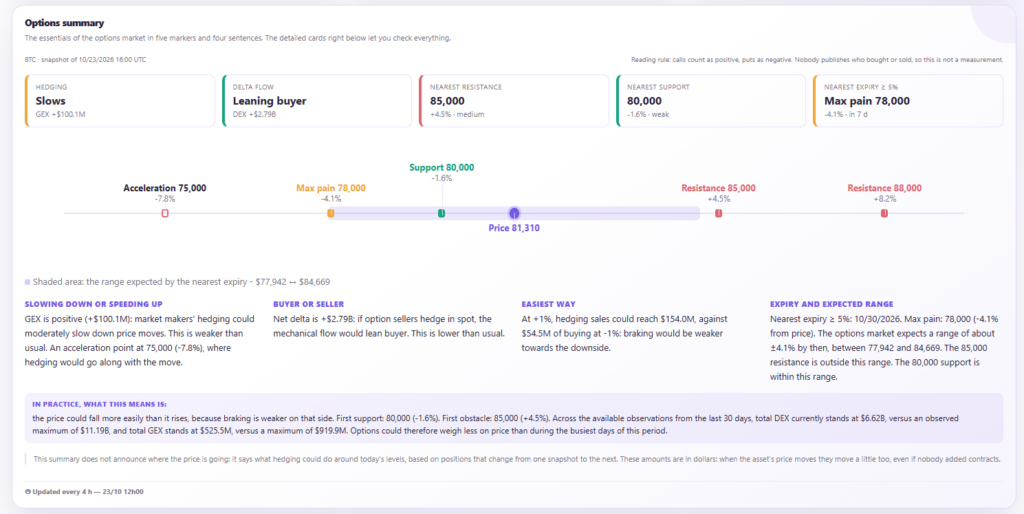
This is the card to read first. It sums up options in five markers and four sentences, with a price scale of plus or minus 10% around the price.
- Hedging: it slows the price down, or goes along with it (the GEX).
- Delta flow: leaning buyer, or leaning seller (the DEX).
- Nearest resistance: the closest level above the price.
- Nearest support: the closest level below the price.
- Nearest expiry: its date and its max pain.
The four sentences each answer a question: is the price slowed down or sped up? Is the flow leaning buyer or seller? In which direction is the path easiest? Where do we stand on the expiry, and what range does the options market expect? The detailed cards, right below, let you check everything.
The cards to understand and check
GEX: slowing down or speeding up?
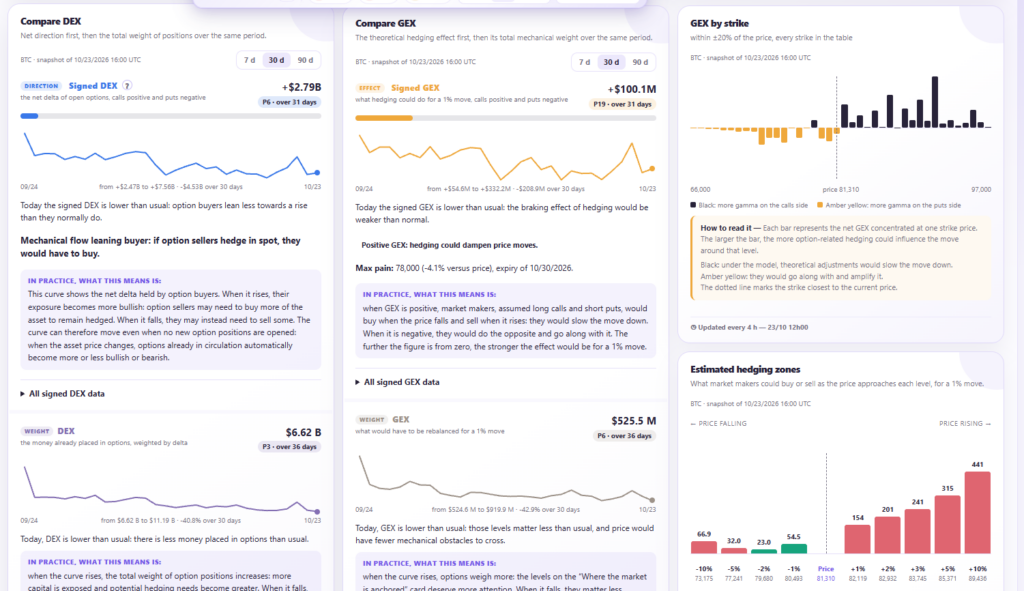
The GEX shows what those who sold options would have to buy or sell to hedge if the price moved by 1%. When it is positive, their hedges could slow the price down. When it is negative, they could go along with it. The further it is from zero, the stronger the effect could be.
DEX: buyer or seller?
The DEX is the net delta of open options: the equivalent, in spot dollars, of the position that option buyers hold. When it rises, their exposure becomes more bullish and option sellers may have to buy more to stay hedged. When it falls, they may instead have to sell.
GEX by strike
This card breaks the GEX down price by price. Each bar represents the net GEX concentrated on one strike, that is, one exercise price. The larger the bar, the more the hedging linked to options could influence the move around that level.
Hedging zones
This card shows what those who sold options could buy or sell as the price approaches each level, for a 1% move. Above the price, a red bar is a level where hedging sales could slow a rise. Below, a green bar is a level where purchases could slow a fall. When the direction is reversed, hedges would go along with the move instead of slowing it.
Where the market is anchored
This card shows what would have to be rebalanced at each price level if the price moved by 1%, based on the options open on Deribit.
Options market: the detail, expiry by expiry
This card lists everything: the open options, expiry by expiry. It is for those who want the detail. For most people, the Summary and the cards above are enough.
⚠️ What you should never do
Do not take these cards for forecasts: they do not announce where the price is going. They only say what hedging could do around current levels, based on positions that change from one snapshot to the next. Max pain, the price at which option buyers would lose the most at expiry, is not a guaranteed target. And the amounts are in dollars: when the price moves, they move too, even if nobody added contracts.
What should they be combined with?
With Smart Liquidity, of which options are one of the three sources, with liquidations, Open Interest, Funding and price structure.
💡 Ya.puka’s advice
Always start with the Options summary. Then use the other cards to check, and observe how the price reacts.